- Products
- Air Compressors & Air Tools
- Climate Control
- Compaction Equipment
- Concrete Cutting Tools & Equipment
- Concrete and Masonry
- Demolition & Excavation
- Electrical & Mechanical
- Fasteners and Anchoring Adhesives
- Floor Protection
- Generators and Welders
- Hand Tools
- Heaters
- Janitorial and Office Supplies
- Jobsite Protection
- Ladders & Storage
- Lighting & Lighting Accessories
- Man Lifts
- Material Handling Equipment
- Power Tools
- Pressure Washers & Pumps
- Safety Gear
- Safety Products
- Saws
- Surface Preparation
- SEASONAL PRODUCTS
- Rentals
- Air Compressor and Air Tool Rentals
- Climate Control Rental
- Compaction Rentals
- Concrete Equipment Rentals
- Demolition & Excavation Equipment Rentals
- Concrete Floor Grinder Rentals
- General Construction Equipment Rentals
- Generator Rentals and Welder Rentals
- Heater Rentals
- Light Tower Rentals
- Man Lift Rentals in Massachusetts and Rhode Island
- Material Handling Equipment Rentals
- Pressure Washer & Pump Rentals
- Saw Rentals in New England
- SEASONAL PRODUCTS
- Products
- Air Compressors & Air Tools
- Climate Control
- Compaction Equipment
- Concrete Cutting Tools & Equipment
- Demolition & Excavation
- Electrical & Mechanical
- Floor Protection
- Generators and Welders
- Construction Heaters
- Construction Ladders, Staging, & Storage
- Construction Lighting
- Man Lifts
- Material Handling Equipment
- Industrial Janitorial and Office Supplies
- Pressure Washers & Pumps
- Construction Safety Products
- Construction Safety Gear
- Surface Preparation
- Building Protection
- Diesel Accessories
- Zero Emissions
- Rentals
- Air Compressor and Air Tool Rentals
- Climate Control Rental
- Compaction Rentals
- Concrete Equipment Rental
- Demolition & Excavation Equipment Rental
- General Construction Equipment Rental
- Generator Rentals and Welder Rentals
- Construction Heaters Rental
- Light Tower Rentals
- Man Lift Rentals
- Material Handling Equipment Rental
- Pressure Washer & Pump Rentals
- Saw Rentals in New England
- Concrete Floor Grinder Rentals
- Zero Emissions Rentals
- Repairs & Used
- Parts
- Blog
- Services
- Resources
- About Us
- Contact Us
Sales & Rental of Construction | Industrial Equipment & Supplies


Why Choose Fire Retardant Nonwoven Fabric?
Fire rarely offers a second chance. The NFPA report Fire Loss in the United States During 2023 recorded approximately 1,504,500 fires across the country. These incidents caused 3,670 civilian deaths, 13,350 injuries, and nearly $48.9 billion in property damage. Such figures make material selection more than a purchasing decision.
Fire Retardant Nonwoven fabrics can slow flame spread, reduce heat release, and support safer evacuation. They appear in protective clothing, filtration media, transportation interiors, construction membranes, and industrial insulation. Smithers’ The Future of Nonwovens to 2028 identifies safety, filtration, and engineered performance as important growth drivers. MarketsandMarkets also projects continued expansion in flame-retardant chemicals, supported by transportation, construction, and electrical applications.
Still, performance depends on the complete product system. Fiber type, basis weight, finishing chemistry, stitching, airflow, and maintenance can change results. A laboratory rating is not a guarantee.
Dr. James A. Milke, a recognized fire-protection engineer and SFPE author, offers a useful caution: “No single material can provide complete fire safety.” That principle should guide every evaluation of Fire Retardant Nonwoven.
Look closely at the test report. Check ignition resistance, flame spread, smoke behavior, and after-flame time. Confirm whether testing followed standards such as ASTM E84, ASTM D6413, EN ISO 6941, or relevant sector requirements. Some products perform impressively on paper, yet disappoint after washing, abrasion, or repeated heat exposure. That uncomfortable gap deserves attention. Choosing responsibly means matching tested performance with real application conditions, verified suppliers, and documented quality control.
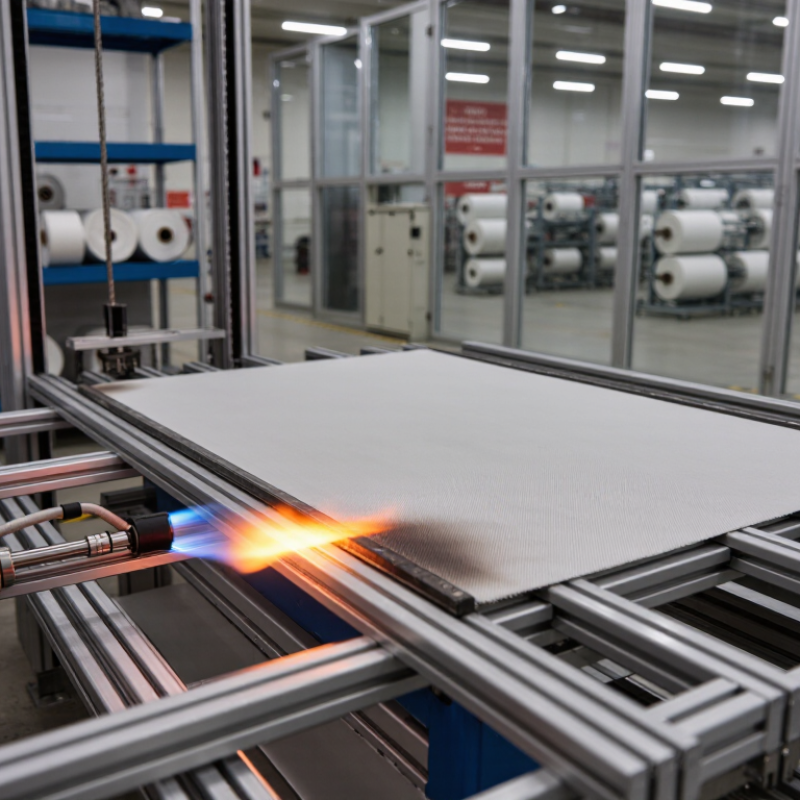
Table of Contents [Hide]
Define Fire-Retardant Nonwoven Fabric Through LOI Values Above 26%
Why Choose Fire Retardant Nonwoven Fabric?
Fire-retardant nonwoven fabric is often defined through its Limiting Oxygen Index, or LOI. An LOI above 26% means the material needs more than 26% oxygen to keep burning. Normal air contains about 20.9% oxygen. Therefore, the fabric is less likely to support continuous combustion in ordinary conditions. Testing methods such as ASTM D2863 and ISO 4589-2 measure this behavior under controlled laboratory conditions.
The number matters, but it is not the whole story. A higher LOI does not automatically prove low smoke, low toxicity, or strong performance beside an open flame. Fabric weight, fiber type, additives, moisture, and finishing can change the result. A sample may pass one test and still perform poorly in a different construction. That is an uncomfortable detail, but it deserves attention.
Industry evidence supports careful material selection. The National Fire Protection Association reported an estimated 1.39 million fires in the United States during 2023. In practical use, a nonwoven layer with an LOI above 26% can help delay ignition and flame spread. Think of a protective panel near wiring or a filter exposed to heat. It may char, shrink, or release smoke before failing. Buyers should request current test reports, production-batch data, and application-specific testing. LOI is a useful starting point, not a complete safety certificate.

© Copyright - Pro Tool & Supply - Site by SVM E-Marketing Solutions - Sitemap
- Privacy policy