- Products
- Air Compressors & Air Tools
- Climate Control
- Compaction Equipment
- Concrete Cutting Tools & Equipment
- Concrete and Masonry
- Demolition & Excavation
- Electrical & Mechanical
- Fasteners and Anchoring Adhesives
- Floor Protection
- Generators and Welders
- Hand Tools
- Heaters
- Janitorial and Office Supplies
- Jobsite Protection
- Ladders & Storage
- Lighting & Lighting Accessories
- Man Lifts
- Material Handling Equipment
- Power Tools
- Pressure Washers & Pumps
- Safety Gear
- Safety Products
- Saws
- Surface Preparation
- SEASONAL PRODUCTS
- Rentals
- Air Compressor and Air Tool Rentals
- Climate Control Rental
- Compaction Rentals
- Concrete Equipment Rentals
- Demolition & Excavation Equipment Rentals
- Concrete Floor Grinder Rentals
- General Construction Equipment Rentals
- Generator Rentals and Welder Rentals
- Heater Rentals
- Light Tower Rentals
- Man Lift Rentals in Massachusetts and Rhode Island
- Material Handling Equipment Rentals
- Pressure Washer & Pump Rentals
- Saw Rentals in New England
- SEASONAL PRODUCTS
- Products
- Air Compressors & Air Tools
- Climate Control
- Compaction Equipment
- Concrete Cutting Tools & Equipment
- Demolition & Excavation
- Electrical & Mechanical
- Floor Protection
- Generators and Welders
- Construction Heaters
- Construction Ladders, Staging, & Storage
- Construction Lighting
- Man Lifts
- Material Handling Equipment
- Industrial Janitorial and Office Supplies
- Pressure Washers & Pumps
- Construction Safety Products
- Construction Safety Gear
- Surface Preparation
- Building Protection
- Diesel Accessories
- Zero Emissions
- Rentals
- Air Compressor and Air Tool Rentals
- Climate Control Rental
- Compaction Rentals
- Concrete Equipment Rental
- Demolition & Excavation Equipment Rental
- General Construction Equipment Rental
- Generator Rentals and Welder Rentals
- Construction Heaters Rental
- Light Tower Rentals
- Man Lift Rentals
- Material Handling Equipment Rental
- Pressure Washer & Pump Rentals
- Saw Rentals in New England
- Concrete Floor Grinder Rentals
- Zero Emissions Rentals
- Repairs & Used
- Parts
- Blog
- Services
- Resources
- About Us
- Contact Us
Sales & Rental of Construction | Industrial Equipment & Supplies


What Is a Trackless Transfer Cart and What Types Are There?
A Trackless Transfer Cart moves materials across a factory or warehouse floor without fixed rails. It typically runs on wheels and uses an electric drive, with an operator or control system directing its route. Some models follow magnetic markers, QR codes, or laser guidance; others are manually steered. The exact setup depends on the facility and the task.
The term describes a broad family of equipment, not one standard design. Common types include flat-deck carts for pallets, V-deck carts for coils, and lift-table carts for adjusting load height. Heavy-duty models carry large components, while compact carts suit narrower work areas. Power and control options create another useful distinction, such as battery-powered, cable-powered, manual, or automated units. These categories can overlap. That matters.
Choosing a cart involves more than matching its rated capacity to the load. Buyers also need to consider load dimensions, floor condition, turning space, travel distance, and how materials are loaded or unloaded. A cart rated for a particular weight may still be unsuitable if the load is uneven or difficult to secure. It is worth checking those details against the actual route, not just a specification sheet. This guide explains how trackless carts work, compares their main types, and outlines the practical factors that shape a suitable choice. Some distinctions are less tidy than product labels suggest. That is worth remembering.
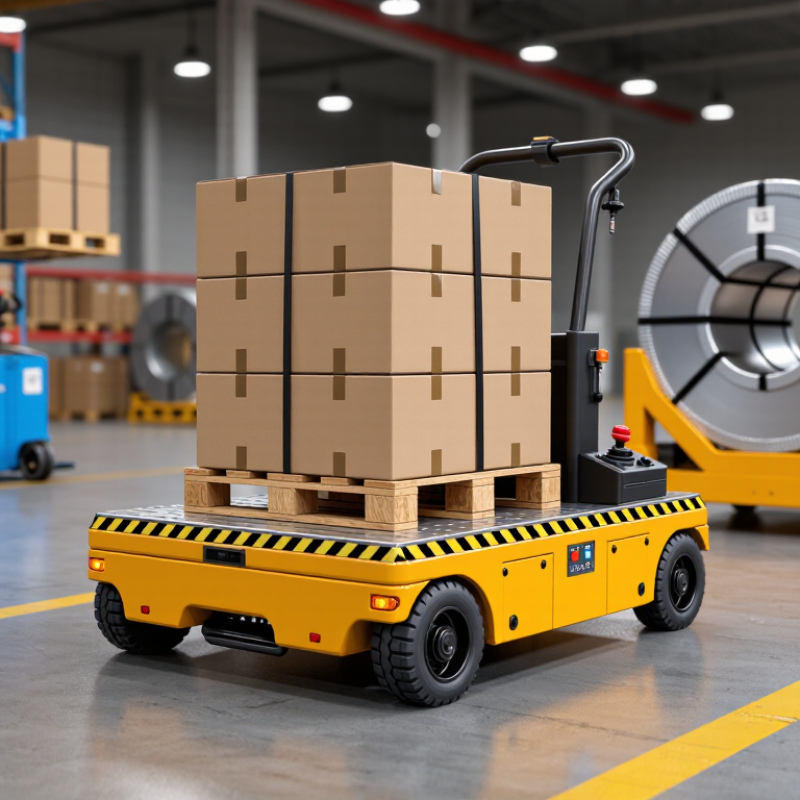
Table of Contents [Hide]
What Is a Trackless Transfer Cart?
A trackless transfer cart is a powered, wheeled platform that carries materials across a factory or warehouse without fixed rails. It may follow an operator, a programmed route, or navigation cues such as floor markers and laser-based maps. Loads sit on a flat deck, rollers, or a lifting surface. Think of a steel pallet moving from a machining cell to a packing area. Quietly, but not magically.
The International Federation of Robotics reported nearly 86,000 professional service robots sold for transportation and logistics in 2022, up 44% from 2021, in its World Robotics 2023 report. This figure covers a wider category of mobile robots, not trackless carts alone, but it shows the growing role of automated material movement. In practice, cart selection depends on payload, route width, floor condition, and how people share the travel path. A small floor crack can matter when a loaded cart crosses it repeatedly. The part that deserves more thought is the workflow: a cart can move reliably, yet still create delays if pickup points or traffic rules are unclear.

© Copyright - Pro Tool & Supply - Site by SVM E-Marketing Solutions - Sitemap
- Privacy policy