- Products
- Air Compressors & Air Tools
- Climate Control
- Compaction Equipment
- Concrete Cutting Tools & Equipment
- Concrete and Masonry
- Demolition & Excavation
- Electrical & Mechanical
- Fasteners and Anchoring Adhesives
- Floor Protection
- Generators and Welders
- Hand Tools
- Heaters
- Janitorial and Office Supplies
- Jobsite Protection
- Ladders & Storage
- Lighting & Lighting Accessories
- Man Lifts
- Material Handling Equipment
- Power Tools
- Pressure Washers & Pumps
- Safety Gear
- Safety Products
- Saws
- Surface Preparation
- SEASONAL PRODUCTS
- Rentals
- Air Compressor and Air Tool Rentals
- Climate Control Rental
- Compaction Rentals
- Concrete Equipment Rentals
- Demolition & Excavation Equipment Rentals
- Concrete Floor Grinder Rentals
- General Construction Equipment Rentals
- Generator Rentals and Welder Rentals
- Heater Rentals
- Light Tower Rentals
- Man Lift Rentals in Massachusetts and Rhode Island
- Material Handling Equipment Rentals
- Pressure Washer & Pump Rentals
- Saw Rentals in New England
- SEASONAL PRODUCTS
- Products
- Air Compressors & Air Tools
- Climate Control
- Compaction Equipment
- Concrete Cutting Tools & Equipment
- Demolition & Excavation
- Electrical & Mechanical
- Floor Protection
- Generators and Welders
- Construction Heaters
- Construction Ladders, Staging, & Storage
- Construction Lighting
- Man Lifts
- Material Handling Equipment
- Industrial Janitorial and Office Supplies
- Pressure Washers & Pumps
- Construction Safety Products
- Construction Safety Gear
- Surface Preparation
- Building Protection
- Diesel Accessories
- Zero Emissions
- Rentals
- Air Compressor and Air Tool Rentals
- Climate Control Rental
- Compaction Rentals
- Concrete Equipment Rental
- Demolition & Excavation Equipment Rental
- General Construction Equipment Rental
- Generator Rentals and Welder Rentals
- Construction Heaters Rental
- Light Tower Rentals
- Man Lift Rentals
- Material Handling Equipment Rental
- Pressure Washer & Pump Rentals
- Saw Rentals in New England
- Concrete Floor Grinder Rentals
- Zero Emissions Rentals
- Repairs & Used
- Parts
- Blog
- Services
- Resources
- About Us
- Contact Us
Sales & Rental of Construction | Industrial Equipment & Supplies


What Are the Top RF Amplifier Types in 2026?
In 2026, choosing an RF Amplifier is less about naming one universal winner and more about matching its design to the signal, frequency, and operating conditions. A low-noise amplifier at a receiver’s input has a different job from a high-power stage feeding an antenna. Small details matter: bandwidth, heat, supply voltage, and even the layout of a board can change real-world performance.
RF amplifier authority Steve C. Cripps has written extensively on power-amplifier design. A useful editorial paraphrase of a principle reflected in his work is: “Efficiency, linearity, and output power must be designed as trade-offs.” This is not a verbatim quotation. It captures why amplifier classes cannot be ranked by a single specification.
The guide explores Class A, B, AB, and C designs, alongside switching and tuned approaches such as Class D, E, and F. It also considers Doherty architectures, broadband amplifiers, low-noise models, and power stages built with GaN or LDMOS devices. Each has a place. None is ideal everywhere. A Class AB unit may offer a practical balance, while a Doherty design can suit demanding power-efficiency needs. But results depend on frequency, modulation, load, and implementation—not labels alone.
Look beyond headline output power. Compare gain, noise figure, bandwidth, linearity, efficiency, and thermal behavior. Check the test conditions, too. A tidy ranking can mislead; real installations are less tidy. This overview provides a grounded starting point for comparing leading RF Amplifier types in 2026 and deciding which trade-offs deserve closer attention.
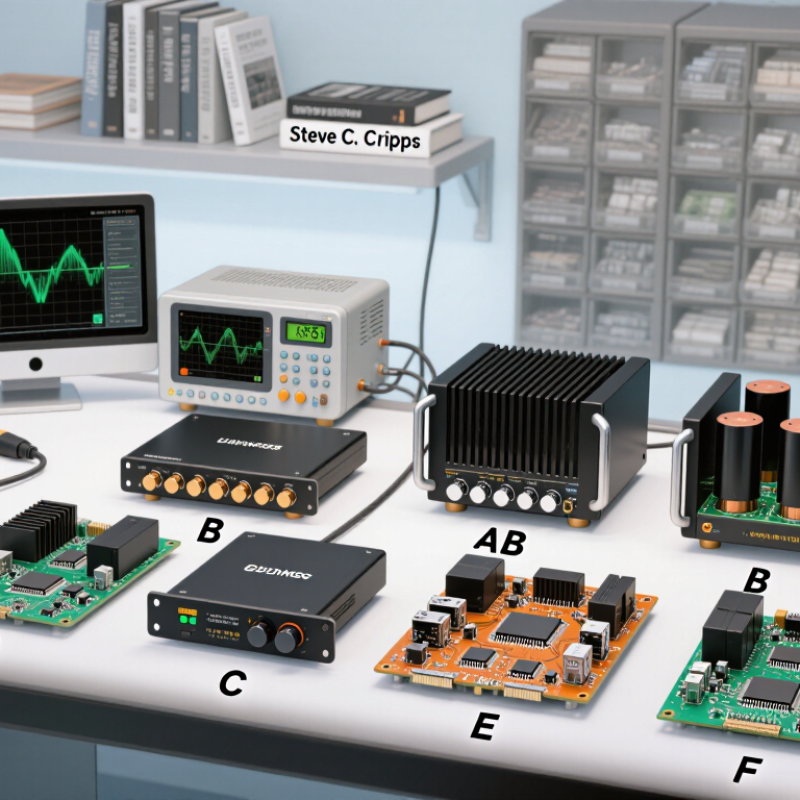
Table of Contents [Hide]
What RF Amplifiers Are and How They Work
An RF amplifier increases the power of a radio-frequency signal while preserving useful information carried by its changing waveform. It may sit between an antenna and a receiver, or near a transmitter’s output. The input can be tiny, sometimes only a few microvolts. The amplifier uses energy from its power supply to produce a stronger version of that signal.
Gain describes how much the signal grows. But more gain is not always better. Excessive amplification can add noise, distort peaks, or make nearby signals interfere. That matters. Engineers also consider frequency range, impedance matching, linearity, and stability. A mismatch at a connector can reflect energy instead of passing it along, while poor thermal design can cause performance to drift as components warm up.
Different RF amplifier designs suit different jobs. Low-noise amplifiers help preserve weak incoming signals; power amplifiers deliver stronger signals toward an antenna; driver stages provide an intermediate boost. These are functional categories, not a universal ranking. In a real circuit, the best choice depends on the signal level, bandwidth, and operating conditions. A clean block diagram can make the design look simple. It rarely shows every trade-off, and even a carefully measured setup may behave differently after cables or loads change.

© Copyright - Pro Tool & Supply - Site by SVM E-Marketing Solutions - Sitemap
- Privacy policy