- Products
- Air Compressors & Air Tools
- Climate Control
- Compaction Equipment
- Concrete Cutting Tools & Equipment
- Concrete and Masonry
- Demolition & Excavation
- Electrical & Mechanical
- Fasteners and Anchoring Adhesives
- Floor Protection
- Generators and Welders
- Hand Tools
- Heaters
- Janitorial and Office Supplies
- Jobsite Protection
- Ladders & Storage
- Lighting & Lighting Accessories
- Man Lifts
- Material Handling Equipment
- Power Tools
- Pressure Washers & Pumps
- Safety Gear
- Safety Products
- Saws
- Surface Preparation
- SEASONAL PRODUCTS
- Rentals
- Air Compressor and Air Tool Rentals
- Climate Control Rental
- Compaction Rentals
- Concrete Equipment Rentals
- Demolition & Excavation Equipment Rentals
- Concrete Floor Grinder Rentals
- General Construction Equipment Rentals
- Generator Rentals and Welder Rentals
- Heater Rentals
- Light Tower Rentals
- Man Lift Rentals in Massachusetts and Rhode Island
- Material Handling Equipment Rentals
- Pressure Washer & Pump Rentals
- Saw Rentals in New England
- SEASONAL PRODUCTS
- Products
- Air Compressors & Air Tools
- Climate Control
- Compaction Equipment
- Concrete Cutting Tools & Equipment
- Demolition & Excavation
- Electrical & Mechanical
- Floor Protection
- Generators and Welders
- Construction Heaters
- Construction Ladders, Staging, & Storage
- Construction Lighting
- Man Lifts
- Material Handling Equipment
- Industrial Janitorial and Office Supplies
- Pressure Washers & Pumps
- Construction Safety Products
- Construction Safety Gear
- Surface Preparation
- Building Protection
- Diesel Accessories
- Zero Emissions
- Rentals
- Air Compressor and Air Tool Rentals
- Climate Control Rental
- Compaction Rentals
- Concrete Equipment Rental
- Demolition & Excavation Equipment Rental
- General Construction Equipment Rental
- Generator Rentals and Welder Rentals
- Construction Heaters Rental
- Light Tower Rentals
- Man Lift Rentals
- Material Handling Equipment Rental
- Pressure Washer & Pump Rentals
- Saw Rentals in New England
- Concrete Floor Grinder Rentals
- Zero Emissions Rentals
- Repairs & Used
- Parts
- Blog
- Services
- Resources
- About Us
- Contact Us
Sales & Rental of Construction | Industrial Equipment & Supplies


2026 Top Plastic Gear Suppliers for Global Buyers?
Choosing a Plastic Gear supplier in 2026 is not just a price comparison. Buyers need to examine material options, tooth accuracy, load capacity, noise, and production consistency. A gear that looks sound in a sample may behave differently after thousands of cycles. Ask suppliers how they validate performance, control dimensional variation, and manage changes between prototype and production. Request measurable data, not only polished product photos.
Robert L. Norton, a machine-design author, states, “Design is the process of applying various techniques and scientific principles for the purpose of defining a device, a process, or a system in sufficient detail to permit its realization.” That principle fits supplier selection well. A capable partner should explain how resin choice, mold design, lubrication, and operating temperature affect the finished gear. Look for evidence such as inspection records, material specifications, and relevant application experience. Shortlist companies that can discuss trade-offs clearly, including limits. A confident answer is not always a reliable one.
This guide compares leading suppliers for global buyers by engineering support, manufacturing capabilities, quality practices, and communication. It also considers practical details: sample lead times, documentation, and whether a supplier can support design changes. One point deserves scrutiny: rankings can simplify a complicated decision. The best fit depends on your load, environment, volume, and risk tolerance.
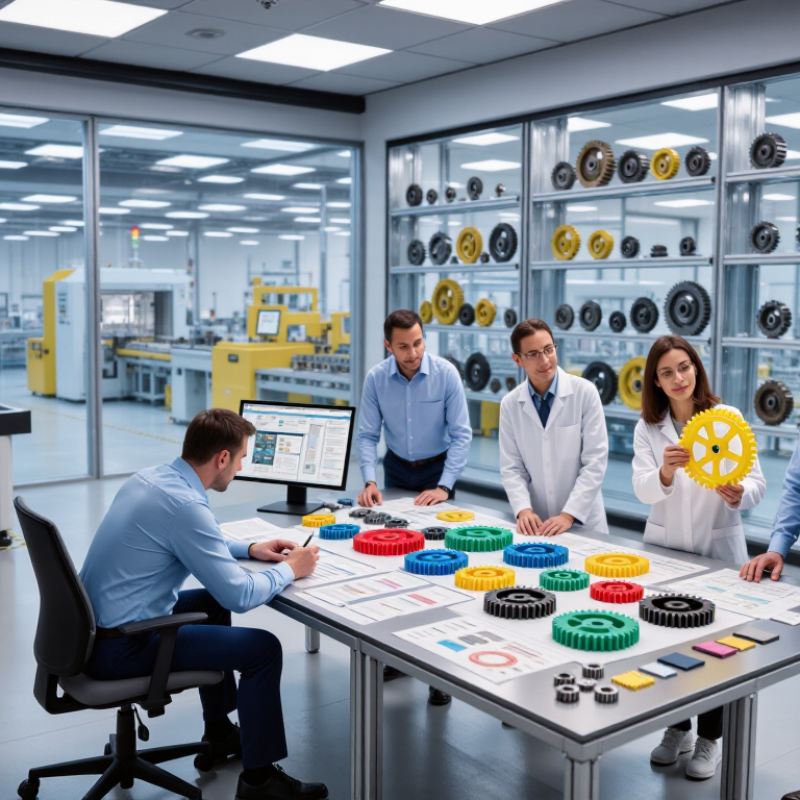
Table of Contents [Hide]
What Plastic Gears Are and How Global Industries Use Them
Plastic gears are toothed components that transfer rotation and torque between shafts. They are usually molded or machined from thermoplastics such as nylon or acetal. Compared with metal gears, they can be lighter, quieter, and resistant to corrosion. Small parts matter. Heat, moisture, and sustained loads can still cause wear, swelling, or tooth deformation.
Global industries use plastic gears in appliance timers, printer feeders, small pumps, automotive seat adjusters, and compact robotic actuators. Picture a motor turning a small gear inside a dashboard vent: low noise and low weight matter, but so does reliable movement after repeated use.
The International Energy Agency’s Global EV Outlook 2024 reports nearly 14 million electric-car sales in 2023, around 18% of worldwide car sales. This is context for growing electrification, not a direct measure of plastic-gear demand.
Material choice and tooth design depend on load, speed, temperature, lubrication, and exposure to moisture. A gear that runs quietly in a dry office printer may perform poorly near a hot motor. Testing under real operating conditions helps reveal those differences. Yet testing can miss long-term wear if cycles are too few.
Plastics Europe reported 413.8 million tonnes of global plastics production in 2023; that broad figure describes the material landscape, not gear output. Buyers should request application-specific performance data, rather than relying on material names alone.

© Copyright - Pro Tool & Supply - Site by SVM E-Marketing Solutions - Sitemap
- Privacy policy