- Products
- Air Compressors & Air Tools
- Climate Control
- Compaction Equipment
- Concrete Cutting Tools & Equipment
- Concrete and Masonry
- Demolition & Excavation
- Electrical & Mechanical
- Fasteners and Anchoring Adhesives
- Floor Protection
- Generators and Welders
- Hand Tools
- Heaters
- Janitorial and Office Supplies
- Jobsite Protection
- Ladders & Storage
- Lighting & Lighting Accessories
- Man Lifts
- Material Handling Equipment
- Power Tools
- Pressure Washers & Pumps
- Safety Gear
- Safety Products
- Saws
- Surface Preparation
- SEASONAL PRODUCTS
- Rentals
- Air Compressor and Air Tool Rentals
- Climate Control Rental
- Compaction Rentals
- Concrete Equipment Rentals
- Demolition & Excavation Equipment Rentals
- Concrete Floor Grinder Rentals
- General Construction Equipment Rentals
- Generator Rentals and Welder Rentals
- Heater Rentals
- Light Tower Rentals
- Man Lift Rentals in Massachusetts and Rhode Island
- Material Handling Equipment Rentals
- Pressure Washer & Pump Rentals
- Saw Rentals in New England
- SEASONAL PRODUCTS
- Products
- Air Compressors & Air Tools
- Climate Control
- Compaction Equipment
- Concrete Cutting Tools & Equipment
- Demolition & Excavation
- Electrical & Mechanical
- Floor Protection
- Generators and Welders
- Construction Heaters
- Construction Ladders, Staging, & Storage
- Construction Lighting
- Man Lifts
- Material Handling Equipment
- Industrial Janitorial and Office Supplies
- Pressure Washers & Pumps
- Construction Safety Products
- Construction Safety Gear
- Surface Preparation
- Building Protection
- Diesel Accessories
- Zero Emissions
- Rentals
- Air Compressor and Air Tool Rentals
- Climate Control Rental
- Compaction Rentals
- Concrete Equipment Rental
- Demolition & Excavation Equipment Rental
- General Construction Equipment Rental
- Generator Rentals and Welder Rentals
- Construction Heaters Rental
- Light Tower Rentals
- Man Lift Rentals
- Material Handling Equipment Rental
- Pressure Washer & Pump Rentals
- Saw Rentals in New England
- Concrete Floor Grinder Rentals
- Zero Emissions Rentals
- Repairs & Used
- Parts
- Blog
- Services
- Resources
- About Us
- Contact Us
Sales & Rental of Construction | Industrial Equipment & Supplies


China Top Longest Range Walkie Talkie Manufacturers
Choosing a Longest Range Walkie Talkie begins with a reality check: advertised distance is not a field guarantee. Hills, concrete walls, antenna position, interference, and battery condition can all change what users hear. In a warehouse, a signal may cross several aisles; outdoors, a ridge can block it in seconds. Range is a system result.
Grand View Research estimated the global two-way radio market at about USD 9.6 billion in 2023 and forecast a 7.2% compound annual growth rate through 2030. These are market estimates, not proof that any model reaches a particular distance. Scope and methods differ between reports. Theodore S. Rappaport, a wireless-communications researcher and author, offers a useful technical lens: wireless performance depends on the channel between antennas. That is a paraphrase of his work, not a direct quotation.
This guide compares China’s leading walkie-talkie manufacturers through practical criteria: radio design, antenna options, battery endurance, durability, documented testing, and support for international buyers. A long-range claim deserves scrutiny. Ask how the range was measured, what terrain was used, and whether the result came from a controlled test or everyday operation. Small details matter: a radio clipped beneath a coat may perform differently from one held upright in open ground. Manufacturer specifications help, but they are only part of the decision. Some comparisons remain imperfect, because test conditions are not always disclosed. That uncertainty should be stated, not hidden.
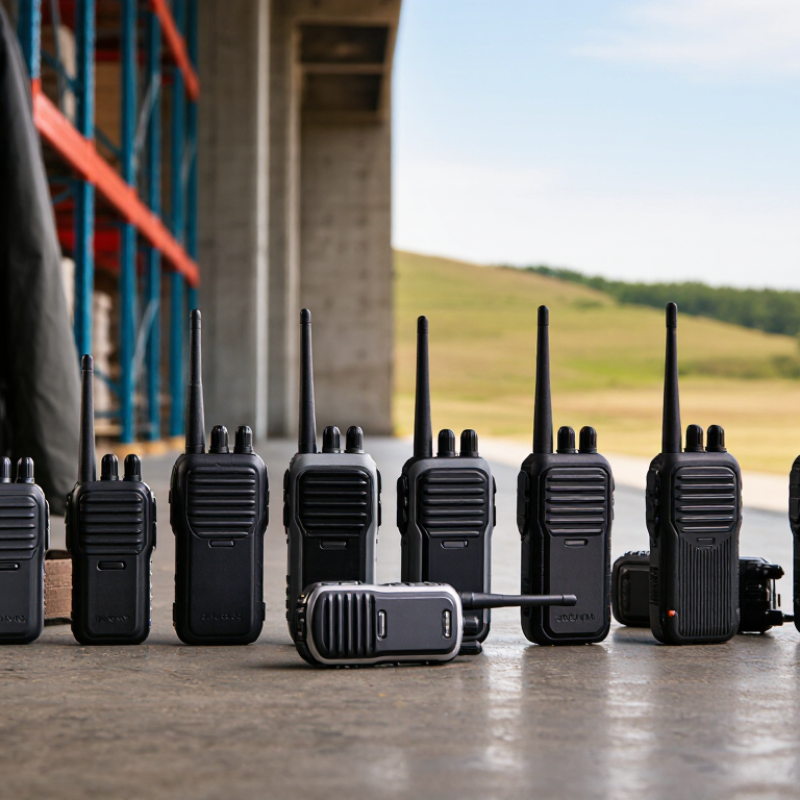
Table of Contents [Hide]
What Defines a Long-Range Walkie-Talkie?
A long-range walkie-talkie is defined by how reliably it communicates across distance, not by a single impressive number on its packaging. Published range figures often describe open, unobstructed conditions. Real use is less predictable. Hills, buildings, trees, antenna placement, and receiver sensitivity can all change the result.
In open terrain, two radios held above waist height may communicate farther than the same units used between concrete buildings. A ridge can block the signal, while a street corner may create a useful path around an obstacle. Dense foliage and metal structures can weaken reception. Small details matter. Even the user’s position can affect a weak signal.
When evaluating range, consider both the radio’s technical specifications and the environment where it will be used. Check whether tests were conducted in open terrain or among buildings, and treat maximum-distance claims as reference points rather than guarantees. Battery condition and antenna integrity also matter during extended use. A practical field test gives a clearer picture, though one test cannot represent every route or season. Range is partly a product feature, and partly a property of the landscape.

© Copyright - Pro Tool & Supply - Site by SVM E-Marketing Solutions - Sitemap
- Privacy policy