- Products
- Air Compressors & Air Tools
- Climate Control
- Compaction Equipment
- Concrete Cutting Tools & Equipment
- Concrete and Masonry
- Demolition & Excavation
- Electrical & Mechanical
- Fasteners and Anchoring Adhesives
- Floor Protection
- Generators and Welders
- Hand Tools
- Heaters
- Janitorial and Office Supplies
- Jobsite Protection
- Ladders & Storage
- Lighting & Lighting Accessories
- Man Lifts
- Material Handling Equipment
- Power Tools
- Pressure Washers & Pumps
- Safety Gear
- Safety Products
- Saws
- Surface Preparation
- SEASONAL PRODUCTS
- Rentals
- Air Compressor and Air Tool Rentals
- Climate Control Rental
- Compaction Rentals
- Concrete Equipment Rentals
- Demolition & Excavation Equipment Rentals
- Concrete Floor Grinder Rentals
- General Construction Equipment Rentals
- Generator Rentals and Welder Rentals
- Heater Rentals
- Light Tower Rentals
- Man Lift Rentals in Massachusetts and Rhode Island
- Material Handling Equipment Rentals
- Pressure Washer & Pump Rentals
- Saw Rentals in New England
- SEASONAL PRODUCTS
- Products
- Air Compressors & Air Tools
- Climate Control
- Compaction Equipment
- Concrete Cutting Tools & Equipment
- Demolition & Excavation
- Electrical & Mechanical
- Floor Protection
- Generators and Welders
- Construction Heaters
- Construction Ladders, Staging, & Storage
- Construction Lighting
- Man Lifts
- Material Handling Equipment
- Industrial Janitorial and Office Supplies
- Pressure Washers & Pumps
- Construction Safety Products
- Construction Safety Gear
- Surface Preparation
- Building Protection
- Diesel Accessories
- Zero Emissions
- Rentals
- Air Compressor and Air Tool Rentals
- Climate Control Rental
- Compaction Rentals
- Concrete Equipment Rental
- Demolition & Excavation Equipment Rental
- General Construction Equipment Rental
- Generator Rentals and Welder Rentals
- Construction Heaters Rental
- Light Tower Rentals
- Man Lift Rentals
- Material Handling Equipment Rental
- Pressure Washer & Pump Rentals
- Saw Rentals in New England
- Concrete Floor Grinder Rentals
- Zero Emissions Rentals
- Repairs & Used
- Parts
- Blog
- Services
- Resources
- About Us
- Contact Us
Sales & Rental of Construction | Industrial Equipment & Supplies


Top 10 Types of Industrial Rigging Equipment
Industrial Rigging is the quiet discipline behind controlled lifting, positioning, and securing operations. A shackle may look small, but its condition, angle, and working load limit can determine an entire lift’s outcome. Slings, wire rope, chain blocks, spreader beams, hoists, and lifting clamps each solve different site problems. They also create different failure points.
Industry data shows why equipment selection deserves careful attention. The U.S. Bureau of Labor Statistics reported 1,069 fatal work injuries in transportation and material-moving occupations during 2023. This figure does not represent rigging incidents alone, but it highlights the risks surrounding material handling. Grand View Research also identifies continued growth in the global lifting equipment market, driven by construction, manufacturing, ports, and energy projects. More equipment means more decisions.
Lifting-industry educator Mike Parnell puts the human factor plainly: “Rigging is a team sport.” That idea matters beside a steel beam, where one person checks the sling and another watches clearance. This guide examines the top 10 types of Industrial Rigging Equipment, including their applications, strengths, limitations, and inspection concerns. It follows practical principles from OSHA requirements and ASME B30 standards. Still, no equipment list fits every site perfectly. Load geometry, sharp edges, temperature, headroom, and operator judgment can change the safest choice. A catalog rating is not a lift plan. That distinction is easy to overlook. It should not be.
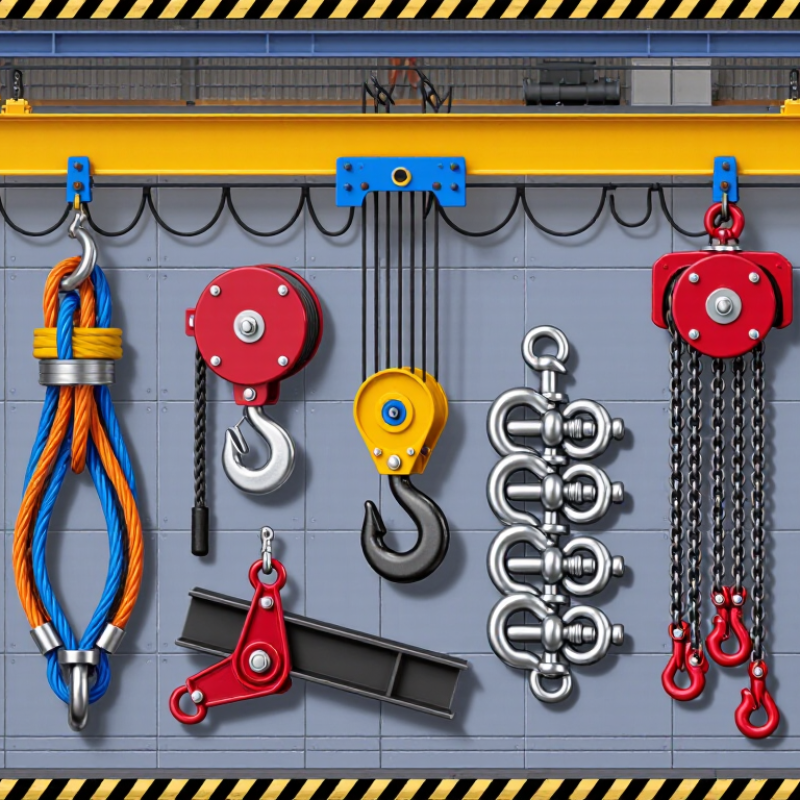
Table of Contents [Hide]
Industrial Rigging Equipment: Purpose, Components, and Applications
Industrial rigging equipment transfers heavy loads safely between lifting points, vehicles, and work areas. Its purpose is simple: control force, balance, and movement. The main components include wire-rope slings, chain slings, synthetic web slings, round slings, shackles, hooks, lifting beams, spreader beams, hoists, and winches. Each item has a rated capacity, connection method, and inspection requirement. A hook carries the load. A shackle joins components. A beam distributes pressure across wider loads.
Applications differ by load shape and working environment. Shipyards often use spreader beams for long steel sections. Warehouses rely on hoists and web slings for machinery placement. Construction crews may combine shackles, chain slings, and lifting beams when loads have uneven centers of gravity. The U.S. Bureau of Labor Statistics reported 1,069 fatal injuries in transportation and material-moving occupations during 2023. That figure reinforces the need for controlled lifting practices, not improvised connections.
Standards such as OSHA 29 CFR 1910.184 and ASME B30.9 emphasize identification, inspection, and removal of damaged slings. The International Labour Organization estimated 2.93 million work-related deaths annually in its 2023 global report. Ratings alone cannot prevent failure. Operators must check abrasion, cuts, bent hooks, stretched links, and distorted fittings before use. A clean tag is not enough. Human judgment still matters, and it can be inconsistent. Load angles are frequently underestimated. Better training, clearer lift plans, and honest pre-use inspections reduce that weakness.

© Copyright - Pro Tool & Supply - Site by SVM E-Marketing Solutions - Sitemap
- Privacy policy