- Products
- Air Compressors & Air Tools
- Climate Control
- Compaction Equipment
- Concrete Cutting Tools & Equipment
- Concrete and Masonry
- Demolition & Excavation
- Electrical & Mechanical
- Fasteners and Anchoring Adhesives
- Floor Protection
- Generators and Welders
- Hand Tools
- Heaters
- Janitorial and Office Supplies
- Jobsite Protection
- Ladders & Storage
- Lighting & Lighting Accessories
- Man Lifts
- Material Handling Equipment
- Power Tools
- Pressure Washers & Pumps
- Safety Gear
- Safety Products
- Saws
- Surface Preparation
- SEASONAL PRODUCTS
- Rentals
- Air Compressor and Air Tool Rentals
- Climate Control Rental
- Compaction Rentals
- Concrete Equipment Rentals
- Demolition & Excavation Equipment Rentals
- Concrete Floor Grinder Rentals
- General Construction Equipment Rentals
- Generator Rentals and Welder Rentals
- Heater Rentals
- Light Tower Rentals
- Man Lift Rentals in Massachusetts and Rhode Island
- Material Handling Equipment Rentals
- Pressure Washer & Pump Rentals
- Saw Rentals in New England
- SEASONAL PRODUCTS
- Products
- Air Compressors & Air Tools
- Climate Control
- Compaction Equipment
- Concrete Cutting Tools & Equipment
- Demolition & Excavation
- Electrical & Mechanical
- Floor Protection
- Generators and Welders
- Construction Heaters
- Construction Ladders, Staging, & Storage
- Construction Lighting
- Man Lifts
- Material Handling Equipment
- Industrial Janitorial and Office Supplies
- Pressure Washers & Pumps
- Construction Safety Products
- Construction Safety Gear
- Surface Preparation
- Building Protection
- Diesel Accessories
- Zero Emissions
- Rentals
- Air Compressor and Air Tool Rentals
- Climate Control Rental
- Compaction Rentals
- Concrete Equipment Rental
- Demolition & Excavation Equipment Rental
- General Construction Equipment Rental
- Generator Rentals and Welder Rentals
- Construction Heaters Rental
- Light Tower Rentals
- Man Lift Rentals
- Material Handling Equipment Rental
- Pressure Washer & Pump Rentals
- Saw Rentals in New England
- Concrete Floor Grinder Rentals
- Zero Emissions Rentals
- Repairs & Used
- Parts
- Blog
- Services
- Resources
- About Us
- Contact Us
Sales & Rental of Construction | Industrial Equipment & Supplies


What Is a Tapered Bearing and How Does It Work?
A Tapered Bearing is designed for loads that challenge ordinary bearings. It supports radial force, axial force, and combined loads in demanding machinery. Its inner and outer raceways form matching cone angles. The rollers sit between these surfaces, creating controlled rolling contact.
Picture a trailer wheel turning under weight. The bearing must carry the load while resisting side forces during a corner. Its geometry helps manage both forces through one compact assembly. The large and small ends of the rollers are guided by the cone-shaped raceways. This arrangement reduces sliding and helps maintain stable rotation.
As bearing researcher Dr. Tedric A. Harris wrote in Rolling Bearing Analysis, “A rolling bearing is a machine element that permits constrained relative motion.” That principle explains the Tapered Bearing clearly. It does not remove friction completely. It controls friction and transfers force more efficiently.
Small details matter. Incorrect preload can create heat, noise, and premature wear. Excessive clearance can allow movement, vibration, and uneven contact. Lubrication also changes performance. Too little lubricant damages surfaces. Too much may increase churning and temperature.
The design looks simple. It is not.
This guide will explain how a Tapered Bearing works, where its forces travel, and why adjustment matters. It will also examine common applications, material choices, lubrication, failure signs, and maintenance practices. Real performance depends on installation, alignment, load, speed, and operating conditions. A bearing can be technically correct yet still fail in service. That uncomfortable possibility deserves attention.
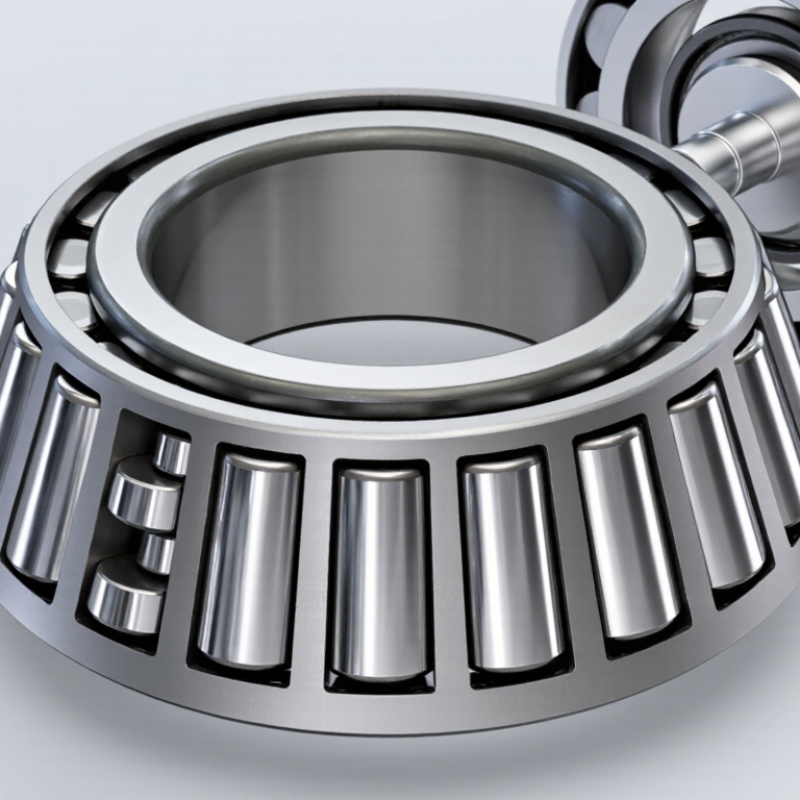
Table of Contents [Hide]
Definition and Basic Structure of a Tapered Bearing
A tapered bearing is a rolling-element bearing designed to carry radial and axial loads at the same time. Its rollers are not straight cylinders; each roller narrows toward one end. The rollers sit between an inner ring, called the cone, and an outer ring, called the cup. These parts form a sloped running path. The cage keeps each roller spaced evenly.
Small details matter.
The bearing’s basic structure includes four working elements: the cone, cup, tapered rollers, and cage.
The cone has a raceway and a rib that guides the larger roller ends. The cup provides the matching outer raceway.
Because both raceways are angled, their contact lines meet at a common point on the bearing axis.
This geometry helps control thrust loads from gears, wheels, or rotating shafts. During inspection, I check roller spacing, raceway condition, and fit security. Uneven marks often reveal poor alignment or incorrect preload.
When the shaft turns, the rollers rotate and orbit between the two rings. Their tapered shape reduces sliding, although it does not remove friction.
Axial force pushes the rollers against the guiding rib, while radial force travels through the raceways.
Correct adjustment is essential. Excessive preload creates heat; too much clearance allows movement and noise.
A simple definition can mislead. Real performance also depends on lubrication, housing stiffness, installation accuracy, and temperature.
One overlooked washer can change the result.

© Copyright - Pro Tool & Supply - Site by SVM E-Marketing Solutions - Sitemap
- Privacy policy