- Products
- Air Compressors & Air Tools
- Climate Control
- Compaction Equipment
- Concrete Cutting Tools & Equipment
- Concrete and Masonry
- Demolition & Excavation
- Electrical & Mechanical
- Fasteners and Anchoring Adhesives
- Floor Protection
- Generators and Welders
- Hand Tools
- Heaters
- Janitorial and Office Supplies
- Jobsite Protection
- Ladders & Storage
- Lighting & Lighting Accessories
- Man Lifts
- Material Handling Equipment
- Power Tools
- Pressure Washers & Pumps
- Safety Gear
- Safety Products
- Saws
- Surface Preparation
- SEASONAL PRODUCTS
- Rentals
- Air Compressor and Air Tool Rentals
- Climate Control Rental
- Compaction Rentals
- Concrete Equipment Rentals
- Demolition & Excavation Equipment Rentals
- Concrete Floor Grinder Rentals
- General Construction Equipment Rentals
- Generator Rentals and Welder Rentals
- Heater Rentals
- Light Tower Rentals
- Man Lift Rentals in Massachusetts and Rhode Island
- Material Handling Equipment Rentals
- Pressure Washer & Pump Rentals
- Saw Rentals in New England
- SEASONAL PRODUCTS
- Products
- Air Compressors & Air Tools
- Climate Control
- Compaction Equipment
- Concrete Cutting Tools & Equipment
- Demolition & Excavation
- Electrical & Mechanical
- Floor Protection
- Generators and Welders
- Construction Heaters
- Construction Ladders, Staging, & Storage
- Construction Lighting
- Man Lifts
- Material Handling Equipment
- Industrial Janitorial and Office Supplies
- Pressure Washers & Pumps
- Construction Safety Products
- Construction Safety Gear
- Surface Preparation
- Building Protection
- Diesel Accessories
- Zero Emissions
- Rentals
- Air Compressor and Air Tool Rentals
- Climate Control Rental
- Compaction Rentals
- Concrete Equipment Rental
- Demolition & Excavation Equipment Rental
- General Construction Equipment Rental
- Generator Rentals and Welder Rentals
- Construction Heaters Rental
- Light Tower Rentals
- Man Lift Rentals
- Material Handling Equipment Rental
- Pressure Washer & Pump Rentals
- Saw Rentals in New England
- Concrete Floor Grinder Rentals
- Zero Emissions Rentals
- Repairs & Used
- Parts
- Blog
- Services
- Resources
- About Us
- Contact Us
Sales & Rental of Construction | Industrial Equipment & Supplies


What Is a Strip Light and What Types Are Available?
A Strip Light is a slim linear lighting product designed to place illumination where conventional fixtures may not fit. It can run beneath kitchen cabinets, trace a ceiling edge, or brighten a display shelf. That flexibility makes it useful, but the name covers products with very different construction and performance. Some use a flexible LED tape with adhesive backing; others use rigid bars or diffused neon-style tubing. Options also vary by color temperature, color-changing controls, brightness, and protection from dust or moisture.
Efficiency is one reason LED-based strip lighting has become widely considered. The U.S. Department of Energy’s Energy Saver guidance reports that LEDs use up to 90% less energy and can last up to 25 times longer than incandescent lighting. These figures describe LEDs broadly, not every Strip Light or installation. A product’s actual performance depends on its components, driver, operating temperature, and use. Specifications matter. Compare lumens per meter, watts per meter, color-rendering index, and the stated ingress-protection rating before choosing. A bright package claim alone tells little.
This guide explains what strip lights are and how common types differ, including single-color, tunable-white, RGB, and addressable models. It also considers where each type works best and what installation details deserve attention. Adhesive may weaken on dusty or warm surfaces; long runs can also show uneven brightness. Those practical limits are easy to overlook. The right choice depends on the room, desired effect, and power setup—not merely the lowest price.
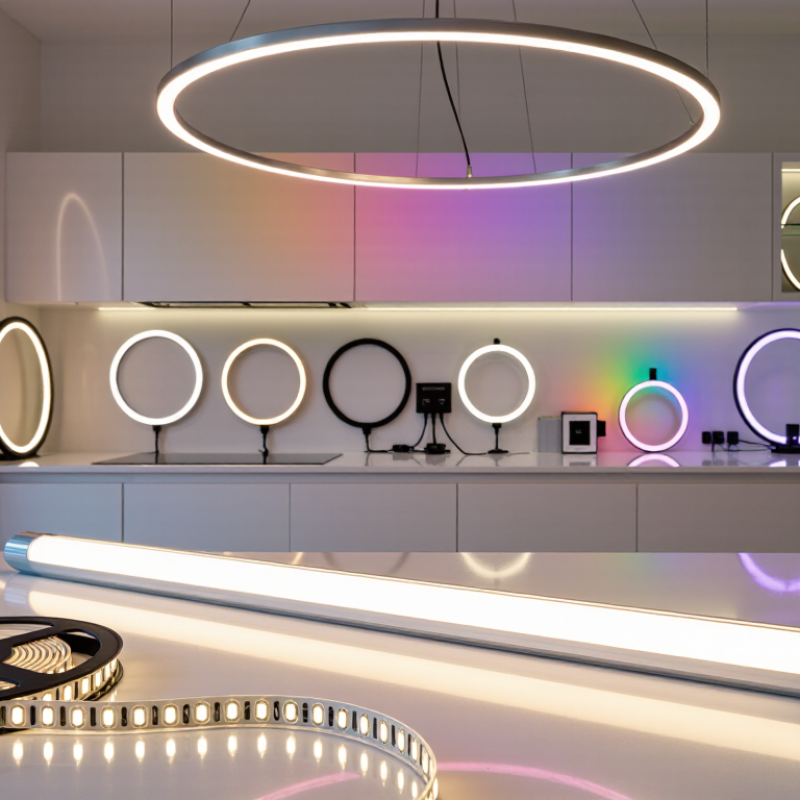
Table of Contents [Hide]
Definition and Basic Structure of a Strip Light
A strip light is a narrow, low-profile lighting assembly built around a flexible or rigid printed circuit board. Small LEDs sit along the board, while copper traces carry electrical current between them. In many constant-voltage strips, resistors divide the LEDs into repeating sections. Cut marks show where a section can be separated without breaking the circuit.
The basic structure also includes a backing layer, often with adhesive, and sometimes a clear protective coating. A power supply converts mains electricity to the voltage the strip requires; connectors join sections or feed power at multiple points. The U.S. Department of Energy’s 2020 U.S. Lighting Market Characterization reported that LEDs made up about 47% of installed U.S. lighting. That shift helps explain their broad use, but it does not mean every strip performs alike. LED spacing, board width, and heat removal all affect brightness and service life. Details matter.
In practical installation, the backing needs a clean, dry surface, and a narrow channel can help manage heat. Adhesive alone may not hold well on dusty paint or textured wood. I have seen this overlooked. Check the strip’s voltage, cut interval, and protection rating before choosing a location; a coated strip is not automatically suitable for every damp area. Finished strips also produce less light per watt than bare LED packages, because the circuit, coating, and heat all influence performance.

© Copyright - Pro Tool & Supply - Site by SVM E-Marketing Solutions - Sitemap
- Privacy policy