- Products
- Air Compressors & Air Tools
- Climate Control
- Compaction Equipment
- Concrete Cutting Tools & Equipment
- Concrete and Masonry
- Demolition & Excavation
- Electrical & Mechanical
- Fasteners and Anchoring Adhesives
- Floor Protection
- Generators and Welders
- Hand Tools
- Heaters
- Janitorial and Office Supplies
- Jobsite Protection
- Ladders & Storage
- Lighting & Lighting Accessories
- Man Lifts
- Material Handling Equipment
- Power Tools
- Pressure Washers & Pumps
- Safety Gear
- Safety Products
- Saws
- Surface Preparation
- SEASONAL PRODUCTS
- Rentals
- Air Compressor and Air Tool Rentals
- Climate Control Rental
- Compaction Rentals
- Concrete Equipment Rentals
- Demolition & Excavation Equipment Rentals
- Concrete Floor Grinder Rentals
- General Construction Equipment Rentals
- Generator Rentals and Welder Rentals
- Heater Rentals
- Light Tower Rentals
- Man Lift Rentals in Massachusetts and Rhode Island
- Material Handling Equipment Rentals
- Pressure Washer & Pump Rentals
- Saw Rentals in New England
- SEASONAL PRODUCTS
- Products
- Air Compressors & Air Tools
- Climate Control
- Compaction Equipment
- Concrete Cutting Tools & Equipment
- Demolition & Excavation
- Electrical & Mechanical
- Floor Protection
- Generators and Welders
- Construction Heaters
- Construction Ladders, Staging, & Storage
- Construction Lighting
- Man Lifts
- Material Handling Equipment
- Industrial Janitorial and Office Supplies
- Pressure Washers & Pumps
- Construction Safety Products
- Construction Safety Gear
- Surface Preparation
- Building Protection
- Diesel Accessories
- Zero Emissions
- Rentals
- Air Compressor and Air Tool Rentals
- Climate Control Rental
- Compaction Rentals
- Concrete Equipment Rental
- Demolition & Excavation Equipment Rental
- General Construction Equipment Rental
- Generator Rentals and Welder Rentals
- Construction Heaters Rental
- Light Tower Rentals
- Man Lift Rentals
- Material Handling Equipment Rental
- Pressure Washer & Pump Rentals
- Saw Rentals in New England
- Concrete Floor Grinder Rentals
- Zero Emissions Rentals
- Repairs & Used
- Parts
- Blog
- Services
- Resources
- About Us
- Contact Us
Sales & Rental of Construction | Industrial Equipment & Supplies


How to Choose the Right Bridge Crane for Your Needs?
Choosing the right Bridge Crane begins with the load, not the catalogue. A 10-ton crane may sound sufficient, yet a 9-ton load with a long lifting radius can expose hidden capacity limits. Duty class, span, lift height, travel speed, duty cycles, building clearance, and future production must be examined together. The European Federation of Materials Handling (FEM) classifies crane usage by load spectrum and operating frequency, while CMAA Specification No. 70 links crane classes with expected service conditions. These standards provide structure, but they cannot replace a site survey.
Market research also shows why selection deserves care. Grand View Research estimates continued growth in the global overhead crane market through 2030, driven by manufacturing, logistics, and infrastructure investment. Fortune Business Insights reports similar expansion, although published market values differ because researchers define “overhead crane” differently. That difference is worth remembering. Numbers can guide decisions, but they should not make the decision alone.
Konecranes states that “safety is always our first priority,” a principle repeatedly emphasized by its industry leadership, including CEO Anders Svensson. The practical meaning is clear: choose controls, brakes, runway components, and maintenance access with real operators in mind. A dusty steel mill needs different protection than a clean warehouse. A fast crane is not automatically a productive crane. I have seen specifications look perfect on paper, then fail to account for low headroom or awkward load shapes. That is the uncomfortable lesson. This guide will compare capacity, configuration, safety, lifecycle cost, and supplier support, helping readers select a Bridge Crane that fits actual work—not merely an attractive quotation.
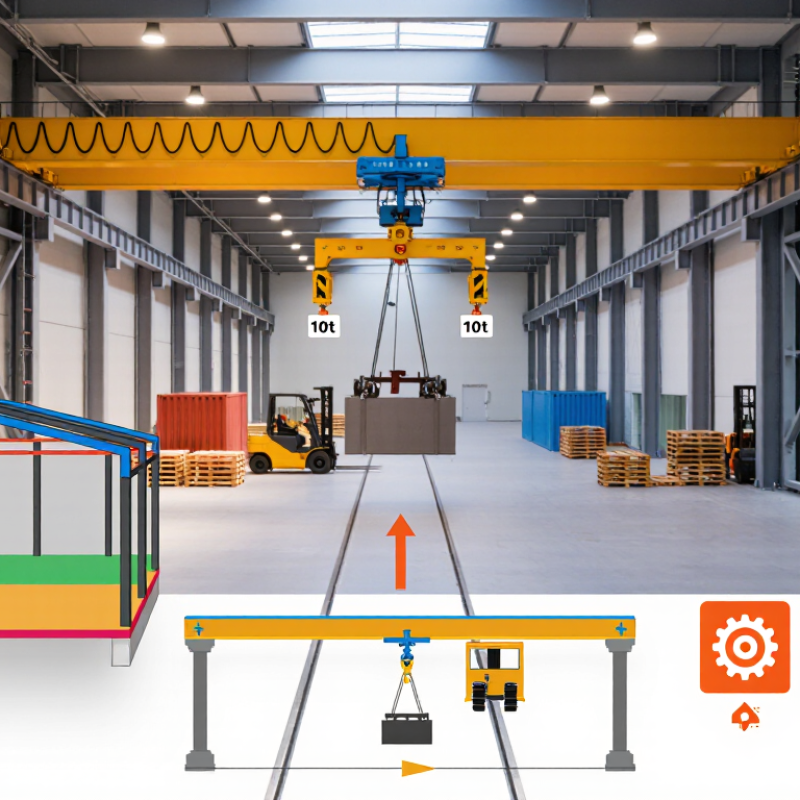
Table of Contents [Hide]
Classify the Load: Capacity, Span, Lift Height, and Duty Cycle
Choosing a bridge crane begins with the load profile, not the hook height. Record the heaviest load, average load, lifting frequency, travel distance, span, and required clearance. Rated capacity must cover the heaviest planned load, including lifting devices and impact effects. Do not size from an average shift.
Span changes structural demand. A longer runway can increase beam deflection, wheel loads, and installation cost. Lift height also needs practical measurement. Include the hook’s lowest position, top-of-load clearance, rope reeving, and maintenance access. A 10-meter lift may require more headroom than the drawing suggests. This detail is often missed.
Duty cycle deserves careful attention. CMAA Specification No. 70 defines service classes from A through F, ranging from standby use to continuous severe service. ISO 4301-1 also evaluates utilization and load-spectrum classes. Count starts, stops, lifts, and trolley movements across a typical week. A crane lifting 2 tonnes repeatedly may face more wear than one lifting 8 tonnes occasionally. That comparison is easy to underestimate. ASME B30.2 guidance should support the final engineering review, while site conditions should control the selection. I would challenge any specification based on one busy day; production patterns change, and “occasional” work can become routine.

© Copyright - Pro Tool & Supply - Site by SVM E-Marketing Solutions - Sitemap
- Privacy policy