- Products
- Air Compressors & Air Tools
- Climate Control
- Compaction Equipment
- Concrete Cutting Tools & Equipment
- Concrete and Masonry
- Demolition & Excavation
- Electrical & Mechanical
- Fasteners and Anchoring Adhesives
- Floor Protection
- Generators and Welders
- Hand Tools
- Heaters
- Janitorial and Office Supplies
- Jobsite Protection
- Ladders & Storage
- Lighting & Lighting Accessories
- Man Lifts
- Material Handling Equipment
- Power Tools
- Pressure Washers & Pumps
- Safety Gear
- Safety Products
- Saws
- Surface Preparation
- SEASONAL PRODUCTS
- Rentals
- Air Compressor and Air Tool Rentals
- Climate Control Rental
- Compaction Rentals
- Concrete Equipment Rentals
- Demolition & Excavation Equipment Rentals
- Concrete Floor Grinder Rentals
- General Construction Equipment Rentals
- Generator Rentals and Welder Rentals
- Heater Rentals
- Light Tower Rentals
- Man Lift Rentals in Massachusetts and Rhode Island
- Material Handling Equipment Rentals
- Pressure Washer & Pump Rentals
- Saw Rentals in New England
- SEASONAL PRODUCTS
- Products
- Air Compressors & Air Tools
- Climate Control
- Compaction Equipment
- Concrete Cutting Tools & Equipment
- Demolition & Excavation
- Electrical & Mechanical
- Floor Protection
- Generators and Welders
- Construction Heaters
- Construction Ladders, Staging, & Storage
- Construction Lighting
- Man Lifts
- Material Handling Equipment
- Industrial Janitorial and Office Supplies
- Pressure Washers & Pumps
- Construction Safety Products
- Construction Safety Gear
- Surface Preparation
- Building Protection
- Diesel Accessories
- Zero Emissions
- Rentals
- Air Compressor and Air Tool Rentals
- Climate Control Rental
- Compaction Rentals
- Concrete Equipment Rental
- Demolition & Excavation Equipment Rental
- General Construction Equipment Rental
- Generator Rentals and Welder Rentals
- Construction Heaters Rental
- Light Tower Rentals
- Man Lift Rentals
- Material Handling Equipment Rental
- Pressure Washer & Pump Rentals
- Saw Rentals in New England
- Concrete Floor Grinder Rentals
- Zero Emissions Rentals
- Repairs & Used
- Parts
- Blog
- Services
- Resources
- About Us
- Contact Us
Sales & Rental of Construction | Industrial Equipment & Supplies


How to Choose the Right Railway Wagon Axle?
Choosing the right Railway Wagon Axle is a safety decision, not merely a purchasing task. The axle carries repeated loads, absorbs track irregularities, and transfers braking forces through the wheelset. A small design mistake can become a large maintenance problem.
Dr. Yukio Ishida, a respected railway wheel–rail researcher, expresses the central engineering concern this way: “Reliable wheel–rail contact is the foundation of safe railway operation.” His statement reminds engineers to examine the complete system, not the axle alone. Load capacity, axle diameter, steel grade, heat treatment, fatigue strength, and wheel-seat design must work together.
Start with the wagon’s maximum gross weight and expected service conditions. A heavy ore wagon needs different margins from a low-load covered wagon. Consider speed, curve frequency, axlebox arrangement, braking cycles, climate, and track quality. Salt air can accelerate corrosion. Poor track alignment can increase impact loads.
Standards matter. So does evidence.
Select an axle that matches applicable railway specifications, certified manufacturing processes, and documented inspection procedures. Ultrasonic testing, dimensional checks, material traceability, and surface-finish control should be part of the evaluation. Ask suppliers for test records, not attractive promises.
The most overlooked detail may be maintenance access. An axle that is difficult to inspect can create hidden risk during service. Field experience also matters. A theoretically strong axle may perform poorly when wheel fits, lubrication, or handling practices are inconsistent.
There is no universal “best” Railway Wagon Axle. The correct choice depends on verified operating data, conservative engineering judgment, and honest review of past failures. Sometimes, the first specification needs questioning. That is healthy engineering.
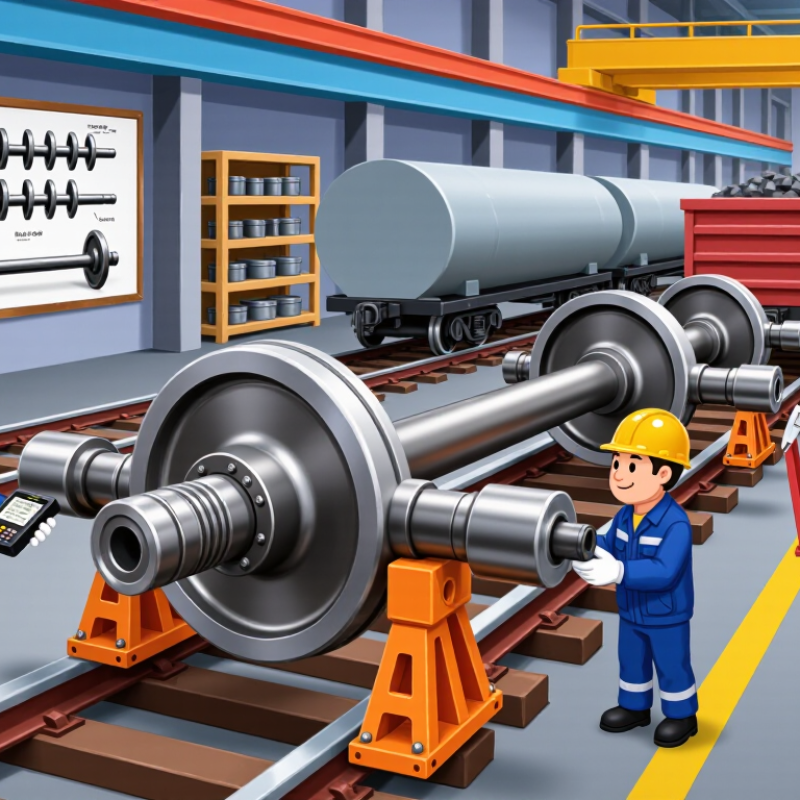
Table of Contents [Hide]
Define the Railway Wagon’s Operating Requirements
How to Choose the Right Railway Wagon Axle?
Define the Railway Wagon’s Operating Requirements
Axle selection begins with the wagon’s real operating profile, not a catalogue dimension. Record payload, tare weight, speed, route length, curve radius, braking cycles, and loading frequency. A 22.5-tonne axle-load class is widely used on standard-gauge freight routes, according to UIC Railway Statistics 2024. However, that figure is only a starting point. Seasonal temperature changes, track quality, and wheel-flat risks can alter the required axle design.
Eurostat’s Rail Transport Statistics 2024 recorded about 375 billion tonne-kilometres of EU rail freight in 2023. This volume shows why duty cycles deserve careful attention. A wagon running short regional trips faces different thermal stresses than one hauling heavy cargo across long corridors. Engineers should calculate vertical loads, lateral forces, fatigue life, bearing loads, and braking heat under the worst credible combination. Check maintenance intervals, inspection access, and corrosion exposure too. Small omissions become expensive later.
Do not select an axle from static load alone. Field measurements can reveal uneven loading, repeated impact events, or wheel unloading that design assumptions miss. Standards such as EN 13103-1 support axle calculations, but they cannot replace route-specific evidence. A practical review should compare measured loads with the design model. The model may be wrong. That possibility deserves attention. Axle material, diameter, hollow or solid construction, and ultrasonic inspection requirements should then match the wagon’s operating environment and approval framework.

© Copyright - Pro Tool & Supply - Site by SVM E-Marketing Solutions - Sitemap
- Privacy policy