- Products
- Air Compressors & Air Tools
- Climate Control
- Compaction Equipment
- Concrete Cutting Tools & Equipment
- Concrete and Masonry
- Demolition & Excavation
- Electrical & Mechanical
- Fasteners and Anchoring Adhesives
- Floor Protection
- Generators and Welders
- Hand Tools
- Heaters
- Janitorial and Office Supplies
- Jobsite Protection
- Ladders & Storage
- Lighting & Lighting Accessories
- Man Lifts
- Material Handling Equipment
- Power Tools
- Pressure Washers & Pumps
- Safety Gear
- Safety Products
- Saws
- Surface Preparation
- SEASONAL PRODUCTS
- Rentals
- Air Compressor and Air Tool Rentals
- Climate Control Rental
- Compaction Rentals
- Concrete Equipment Rentals
- Demolition & Excavation Equipment Rentals
- Concrete Floor Grinder Rentals
- General Construction Equipment Rentals
- Generator Rentals and Welder Rentals
- Heater Rentals
- Light Tower Rentals
- Man Lift Rentals in Massachusetts and Rhode Island
- Material Handling Equipment Rentals
- Pressure Washer & Pump Rentals
- Saw Rentals in New England
- SEASONAL PRODUCTS
- Products
- Air Compressors & Air Tools
- Climate Control
- Compaction Equipment
- Concrete Cutting Tools & Equipment
- Demolition & Excavation
- Electrical & Mechanical
- Floor Protection
- Generators and Welders
- Construction Heaters
- Construction Ladders, Staging, & Storage
- Construction Lighting
- Man Lifts
- Material Handling Equipment
- Industrial Janitorial and Office Supplies
- Pressure Washers & Pumps
- Construction Safety Products
- Construction Safety Gear
- Surface Preparation
- Building Protection
- Diesel Accessories
- Zero Emissions
- Rentals
- Air Compressor and Air Tool Rentals
- Climate Control Rental
- Compaction Rentals
- Concrete Equipment Rental
- Demolition & Excavation Equipment Rental
- General Construction Equipment Rental
- Generator Rentals and Welder Rentals
- Construction Heaters Rental
- Light Tower Rentals
- Man Lift Rentals
- Material Handling Equipment Rental
- Pressure Washer & Pump Rentals
- Saw Rentals in New England
- Concrete Floor Grinder Rentals
- Zero Emissions Rentals
- Repairs & Used
- Parts
- Blog
- Services
- Resources
- About Us
- Contact Us
Sales & Rental of Construction | Industrial Equipment & Supplies


How to Choose the Best China Vehicle Wedge Barrier?
Choosing the best Vehicle Wedge Barrier begins with risk, not appearance. A polished steel wedge may look impressive, yet performance depends on impact rating, foundation depth, traffic flow, and maintenance access. Grand View Research’s 2024 Physical Security Market report describes increasing demand for integrated perimeter protection, driven by critical infrastructure, transport, and commercial facilities. That trend matters. Security budgets are growing, but poor site assessments still create expensive weaknesses.
The U.S. Cybersecurity and Infrastructure Security Agency’s vehicle-ramming guidance recommends layered, risk-based protection rather than relying on one device. Buyers should compare ASTM F2656 or IWA 14-1 test ratings, vehicle speed assumptions, wedge height, cycle capacity, drainage, and emergency-release functions. A barrier rated for a heavy truck is not automatically suitable for a hospital entrance. A shallow foundation can limit real-world resistance. Check the drawings.
Security technologist Bruce Schneier offers a useful principle: “Security is a process, not a product.” Applied here, the best Vehicle Wedge Barrier must work with bollards, gates, CCTV, access control, and trained operators. NPSA guidance also stresses hostile vehicle mitigation planning, site assessment, and operational maintenance. Those details are often overlooked.
Experience reveals an uncomfortable point. Higher impact ratings can increase cost, noise, installation time, and repair complexity. That assumption can fail. A careful selection should measure daily traffic, turning space, snow or rain exposure, pedestrian movement, and service response times. Review independent crash-test evidence, manufacturer experience, warranty terms, and local engineering requirements before purchase. The strongest choice is not always the largest barrier. It is the one that performs reliably at the site’s actual risk level.
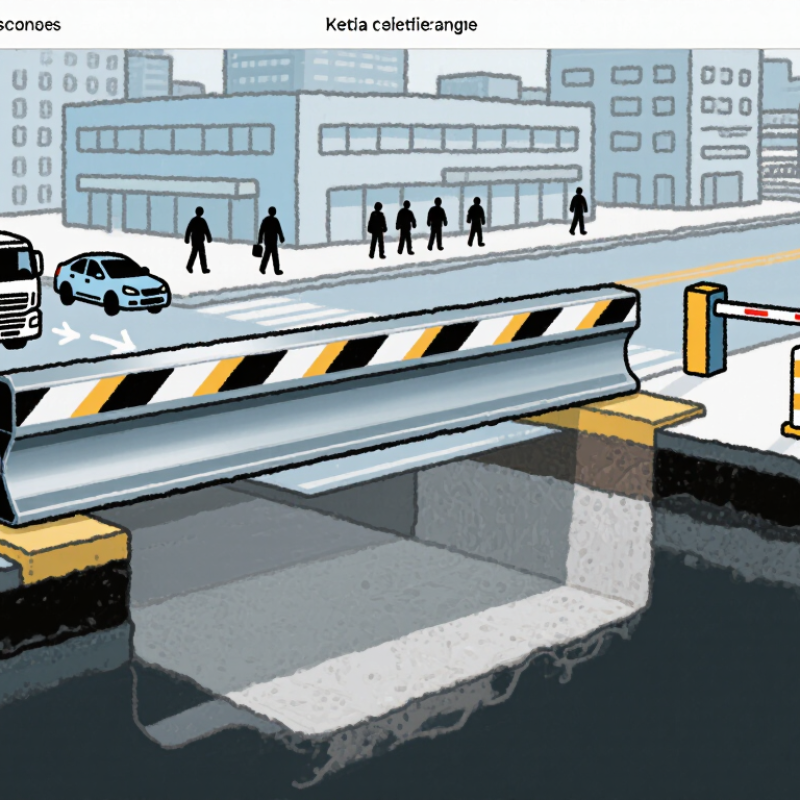
Table of Contents [Hide]
Understanding Vehicle Wedge Barriers and Their Security Functions
A vehicle wedge barrier is more than a steel plate rising from the road. It is a controlled security device designed to restrict unauthorized vehicle access. When activated, the wedge lifts quickly and creates a physical obstruction across an entrance. When lowered, it should allow smooth passage for approved vehicles.
Its security function depends on several connected parts. A strong frame transfers impact forces into the foundation. Hydraulic or electromechanical systems control movement and response time. Sensors can detect vehicle position, while access control systems manage authorized entry. Drainage is equally important. Standing water can damage motors, sensors, and electrical connections.
Site conditions should guide the selection. Measure lane width, pavement depth, traffic frequency, and available drainage. A barrier for a warehouse entrance may need different performance from one used at a public facility. Review independently tested impact ratings, operating cycles, emergency lowering functions, and maintenance access. Installation quality matters just as much as the product specification.
Small details often decide reliability.
For example, a poorly aligned wedge may scrape vehicles or create dangerous gaps. A noisy motor may indicate wear before complete failure. Regular inspections should check hinges, seals, warning lights, control cabinets, and backup power. No system is perfect. A high rating on paper cannot correct weak concrete or careless maintenance. The better choice is the barrier that matches the site, receives documented testing, and remains practical for daily operators.
How to Choose the Best China Vehicle Wedge Barrier? - Understanding Vehicle Wedge Barriers and Their Security Functions
| Selection Dimension | Typical Industry Data | Security Function | Recommended Evaluation Point |
|---|---|---|---|
| Barrier Type | Fixed, hydraulic automatic, electromechanical automatic, or manually operated | Controls whether vehicles can enter or leave a protected lane | Choose automatic operation for frequent traffic and fixed protection for permanently restricted areas |
| Wedge Height | Common raised height: approximately 400–1,000 mm | Creates a physical obstacle that can lift or stop an unauthorized vehicle | Select a height that matches the required threat level without restricting emergency or service vehicles |
| Overall Barrier Width | Typical single-lane coverage: approximately 2,000–4,000 mm; custom widths are possible | Blocks the full vehicle passage rather than only part of the lane | Confirm lane width, road curvature, drainage conditions, and available foundation space |
| Buried Foundation Depth | Shallow models: approximately 200–350 mm; deep models: approximately 500–1,000 mm | Provides structural support and allows the wedge mechanism to operate below road level | Use shallow installation where underground utilities, groundwater, or limited excavation are concerns |
| Impact Resistance | May be specified by ASTM F2656, IWA 14-1, BSI PAS 68, or equivalent test classifications | Reduces vehicle penetration through a protected perimeter | Request a test report stating vehicle mass, impact speed, penetration distance, and test configuration |
| Vehicle Impact Speed Rating | Certified systems may be tested at approximately 30–80 km/h, depending on the standard and rating | Defines the tested collision-energy level the barrier can resist | Do not compare speed ratings alone; verify the tested vehicle mass and penetration result |
| Operating Speed | Typical full raise or lower time: approximately 3–8 seconds | Controls how quickly a lane can be secured or reopened | Balance rapid response with vehicle clearance, pedestrian safety, and mechanical load |
| Traffic Capacity | Common duty ratings range from approximately 100 to 1,000 cycles per day | Determines suitability for low-traffic entrances or continuously used gates | Choose a higher-duty actuator for logistics facilities, transport hubs, and busy checkpoints |
| Drive System | Hydraulic systems provide high force; electromechanical systems simplify maintenance and control | Raises and lowers the wedge under normal and controlled emergency operation | Compare operating temperature, service access, leakage risk, noise, and backup operation |
| Material and Surface Finish | Structural steel with hot-dip galvanizing, protective coating, or stainless-steel components | Resists impact, corrosion, moisture, and repeated vehicle loading | Match corrosion protection to rainfall, coastal exposure, de-icing salts, and chemical conditions |
| Ingress Protection | Outdoor control cabinets and electrical components are commonly specified at IP54–IP66 | Limits dust and water entry into control equipment | Use a higher IP rating in exposed outdoor locations or areas subject to washdown |
| Safety Detection | Common devices include inductive loops, photoelectric sensors, radar, safety edges, and warning lights | Helps prevent the wedge from moving when a vehicle or person is in the danger zone | Require presence detection, obstruction protection, audible or visual warning, and emergency stop control |
| Power Supply | Typical control input: 110–240 V AC; motor and hydraulic power ratings vary by design | Provides reliable energy for raising, lowering, monitoring, and access control | Verify local voltage, phase requirements, surge protection, grounding, and standby power needs |
| Emergency Release | Manual override, hydraulic release, battery backup, or controlled lower-on-power-failure functions | Allows authorized access or emergency evacuation during power loss or system faults | Define whether the site requires fail-safe or fail-secure behavior |
| Access-Control Compatibility | Can commonly interface with card readers, keypads, remote controls, intercoms, vehicle detection, and security systems | Allows the barrier to operate as part of a coordinated perimeter-security system | Confirm dry-contact inputs, relay outputs, communication protocols, and system integration requirements |
| Drainage and Water Management | Drainage pumps, gravel beds, channels, or site-specific stormwater connections may be required | Reduces flooding, corrosion, freezing, and actuator failure in below-ground equipment | Inspect groundwater level, rainfall intensity, drainage capacity, and winter freezing conditions before installation |
| Maintenance Requirements | Routine inspection, cleaning, lubrication, sensor testing, drainage checks, and fastener inspection | Maintains dependable operation and preserves the intended security performance | Evaluate access to service points, spare-part availability, maintenance intervals, and local technical support |
| Best-Fit Applications | Government sites, data centers, military facilities, airports, ports, industrial plants, and high-security entrances | Provides visible access control and vehicle intrusion resistance | Select the model according to threat assessment, traffic volume, site layout, and required certification |
Note: The figures shown are typical industry ranges for preliminary selection. Final performance must be verified through the specific product drawings, installation requirements, duty-cycle data, and independently documented impact-test results.

© Copyright - Pro Tool & Supply - Site by SVM E-Marketing Solutions - Sitemap
- Privacy policy