- Products
- Air Compressors & Air Tools
- Climate Control
- Compaction Equipment
- Concrete Cutting Tools & Equipment
- Concrete and Masonry
- Demolition & Excavation
- Electrical & Mechanical
- Fasteners and Anchoring Adhesives
- Floor Protection
- Generators and Welders
- Hand Tools
- Heaters
- Janitorial and Office Supplies
- Jobsite Protection
- Ladders & Storage
- Lighting & Lighting Accessories
- Man Lifts
- Material Handling Equipment
- Power Tools
- Pressure Washers & Pumps
- Safety Gear
- Safety Products
- Saws
- Surface Preparation
- SEASONAL PRODUCTS
- Rentals
- Air Compressor and Air Tool Rentals
- Climate Control Rental
- Compaction Rentals
- Concrete Equipment Rentals
- Demolition & Excavation Equipment Rentals
- Concrete Floor Grinder Rentals
- General Construction Equipment Rentals
- Generator Rentals and Welder Rentals
- Heater Rentals
- Light Tower Rentals
- Man Lift Rentals in Massachusetts and Rhode Island
- Material Handling Equipment Rentals
- Pressure Washer & Pump Rentals
- Saw Rentals in New England
- SEASONAL PRODUCTS
- Products
- Air Compressors & Air Tools
- Climate Control
- Compaction Equipment
- Concrete Cutting Tools & Equipment
- Demolition & Excavation
- Electrical & Mechanical
- Floor Protection
- Generators and Welders
- Construction Heaters
- Construction Ladders, Staging, & Storage
- Construction Lighting
- Man Lifts
- Material Handling Equipment
- Industrial Janitorial and Office Supplies
- Pressure Washers & Pumps
- Construction Safety Products
- Construction Safety Gear
- Surface Preparation
- Building Protection
- Diesel Accessories
- Zero Emissions
- Rentals
- Air Compressor and Air Tool Rentals
- Climate Control Rental
- Compaction Rentals
- Concrete Equipment Rental
- Demolition & Excavation Equipment Rental
- General Construction Equipment Rental
- Generator Rentals and Welder Rentals
- Construction Heaters Rental
- Light Tower Rentals
- Man Lift Rentals
- Material Handling Equipment Rental
- Pressure Washer & Pump Rentals
- Saw Rentals in New England
- Concrete Floor Grinder Rentals
- Zero Emissions Rentals
- Repairs & Used
- Parts
- Blog
- Services
- Resources
- About Us
- Contact Us
Sales & Rental of Construction | Industrial Equipment & Supplies


How to Choose the Right Ceramic Balls in 2026?
Choosing the right Ceramic Ball in 2026 means matching material and grade to the job, not simply buying the hardest option. A bearing running at high speed has different needs from a valve exposed to abrasive slurry or a pump handling corrosive fluids. Alumina, zirconia, and silicon nitride differ in density, toughness, chemical resistance, and cost. Small differences matter. A ball that performs well in a catalog may behave differently under heat, poor lubrication, or repeated impact.
Several references help make the choice more evidence-based. ISO 3290-2:2014 sets dimensional and tolerance requirements for ceramic balls used in rolling bearings; it does not, by itself, guarantee service life in a particular machine. Grand View Research’s Ceramic Balls Market report tracks market demand by material and application, offering useful context, though forecasts are not purchase specifications. The U.S. Geological Survey’s Mineral Commodity Summaries 2025 covers supply information for materials including alumina-related inputs and zirconium. That matters when sourcing and price stability enter the decision. Yet reports have limits. They cannot replace samples, operating data, or a careful review of the actual load, temperature, speed, and lubricant. Before comparing suppliers, define those conditions and ask for documented dimensions, material composition, and inspection results. One detail is easy to miss: “ceramic” is not a single performance category. A sound choice starts with the operating conditions, then checks whether the evidence supports the promised performance.
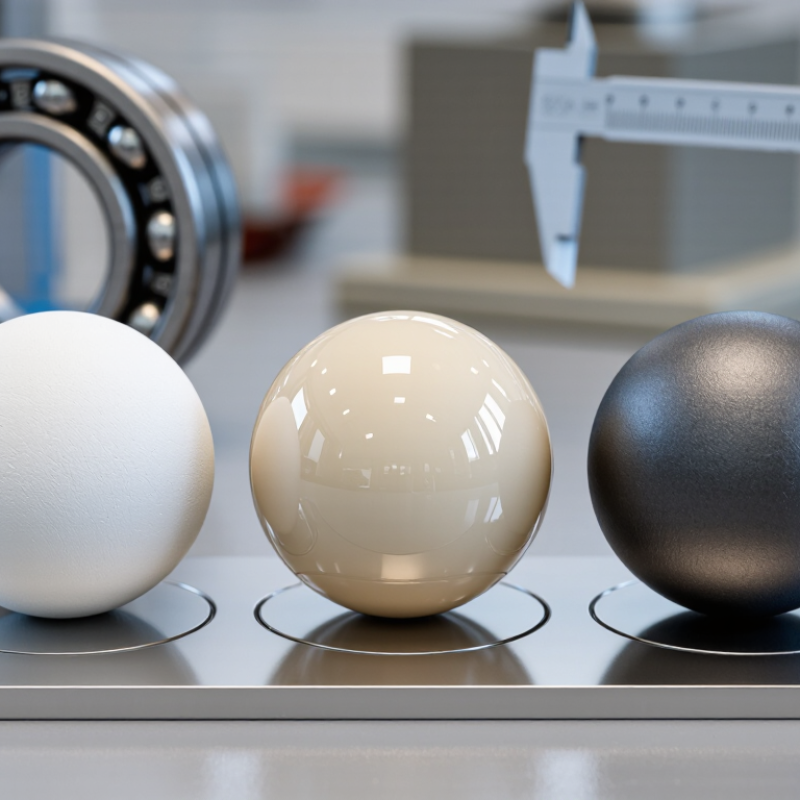
Table of Contents [Hide]
Ceramic Ball Types and Their Core Properties
Ceramic balls may look alike in a sample tray, but their core properties differ sharply. Alumina Balls offer high hardness, wear resistance, and broad chemical stability, making them a practical choice for many grinding and support duties. They are not indestructible; impact and poor fit can still cause chipping. Zirconia is denser and tougher, so it can deliver efficient milling with less contamination from wear. Its higher cost may not be justified for every process.
Silicon nitride combines low density with strong fatigue and thermal-shock resistance. It suits demanding bearing and high-speed applications, where weight and heat matter. Silicon carbide handles high temperatures and resists many corrosive environments, but its brittleness calls for careful installation. Steatite is generally more economical, though its performance limits may rule it out under heavy loads. That matters.
Match the material to operating temperature, load, speed, fluid chemistry, and acceptable wear—not just to a hardness figure. Ask for test data under conditions close to your process, and check ball size tolerance and surface finish. A neat comparison chart cannot predict every real installation. Sometimes the best choice becomes clear only after a small, controlled trial.

© Copyright - Pro Tool & Supply - Site by SVM E-Marketing Solutions - Sitemap
- Privacy policy