- Products
- Air Compressors & Air Tools
- Climate Control
- Compaction Equipment
- Concrete Cutting Tools & Equipment
- Concrete and Masonry
- Demolition & Excavation
- Electrical & Mechanical
- Fasteners and Anchoring Adhesives
- Floor Protection
- Generators and Welders
- Hand Tools
- Heaters
- Janitorial and Office Supplies
- Jobsite Protection
- Ladders & Storage
- Lighting & Lighting Accessories
- Man Lifts
- Material Handling Equipment
- Power Tools
- Pressure Washers & Pumps
- Safety Gear
- Safety Products
- Saws
- Surface Preparation
- SEASONAL PRODUCTS
- Rentals
- Air Compressor and Air Tool Rentals
- Climate Control Rental
- Compaction Rentals
- Concrete Equipment Rentals
- Demolition & Excavation Equipment Rentals
- Concrete Floor Grinder Rentals
- General Construction Equipment Rentals
- Generator Rentals and Welder Rentals
- Heater Rentals
- Light Tower Rentals
- Man Lift Rentals in Massachusetts and Rhode Island
- Material Handling Equipment Rentals
- Pressure Washer & Pump Rentals
- Saw Rentals in New England
- SEASONAL PRODUCTS
- Products
- Air Compressors & Air Tools
- Climate Control
- Compaction Equipment
- Concrete Cutting Tools & Equipment
- Demolition & Excavation
- Electrical & Mechanical
- Floor Protection
- Generators and Welders
- Construction Heaters
- Construction Ladders, Staging, & Storage
- Construction Lighting
- Man Lifts
- Material Handling Equipment
- Industrial Janitorial and Office Supplies
- Pressure Washers & Pumps
- Construction Safety Products
- Construction Safety Gear
- Surface Preparation
- Building Protection
- Diesel Accessories
- Zero Emissions
- Rentals
- Air Compressor and Air Tool Rentals
- Climate Control Rental
- Compaction Rentals
- Concrete Equipment Rental
- Demolition & Excavation Equipment Rental
- General Construction Equipment Rental
- Generator Rentals and Welder Rentals
- Construction Heaters Rental
- Light Tower Rentals
- Man Lift Rentals
- Material Handling Equipment Rental
- Pressure Washer & Pump Rentals
- Saw Rentals in New England
- Concrete Floor Grinder Rentals
- Zero Emissions Rentals
- Repairs & Used
- Parts
- Blog
- Services
- Resources
- About Us
- Contact Us
Sales & Rental of Construction | Industrial Equipment & Supplies


7 Best Vacuum Coating Machines for Industrial Buyers
Choosing among the 7 best vacuum coating machines for industrial buyers starts with the coating job, not the brochure. A vacuum coating machine must suit the substrate, target film, production volume, and available floor space. A glossy sample is useful. It is not enough.
Donald M. Mattox, a respected author on physical vapor deposition, has written extensively about PVD processes and their practical requirements. A useful paraphrase of that approach is: “Match the deposition process to the coating, substrate, and production target.” This is a paraphrase, not a verbatim quotation. In practice, buyers should compare chamber size, pumping capacity, process controls, service access, and compatibility with their materials. Picture a technician loading a batch of metal components: awkward fixtures or slow pump-down cycles can affect daily output. Details matter.
The right choice depends on the application. Optical films, decorative finishes, and wear-resistant coatings may call for different process configurations. Ask vendors for sample runs, process documentation, and clear service terms. Check what the machine can repeat, not only what it can achieve once. Small caveat. Published specifications do not always reflect a buyer’s actual parts or workflow. This guide compares seven options through practical selection criteria, while recognizing that the best machine on paper may not be the best fit on the factory floor.
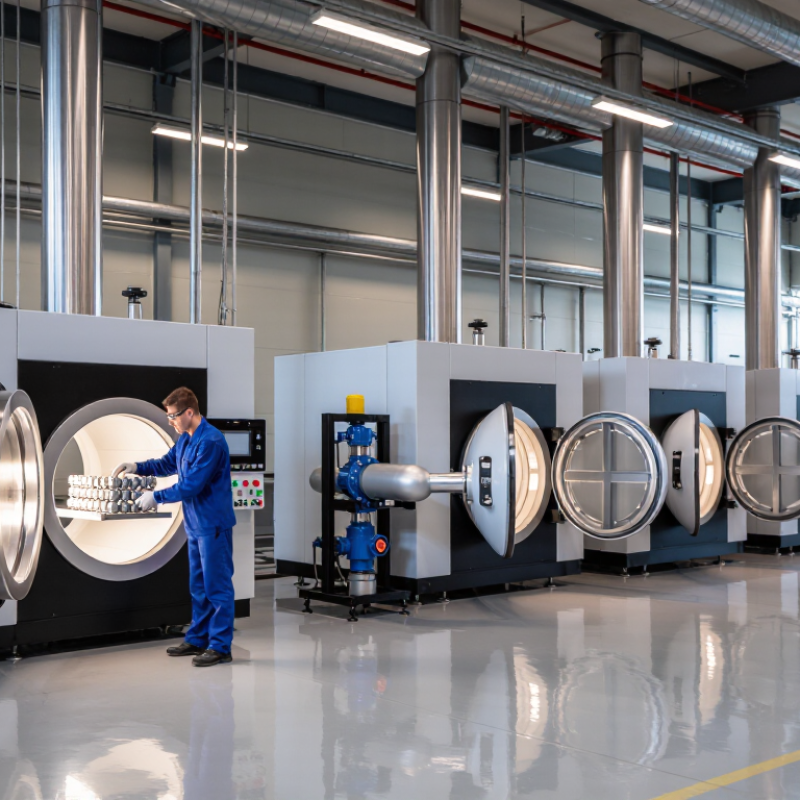
Table of Contents [Hide]
How Industrial Vacuum Coating Machines Work
Industrial vacuum coating machines create a controlled, low-pressure space so coating atoms can travel with fewer collisions. A typical system uses a sealed chamber, mechanical and high-vacuum pumps, pressure gauges, a substrate holder, and a deposition source. Operators clean and load the parts, evacuate the chamber, then introduce a measured process gas or heat a solid coating material. In sputtering, plasma ions knock atoms from a target; in evaporation, heat turns source material into vapor. The atoms cross the chamber and condense on cooler surfaces. Small details matter. Fingerprints can weaken adhesion.
Pressure changes the journey. Leybold’s Fundamentals of Vacuum Technology gives an air mean free path of roughly 68 nanometers near atmospheric pressure. Using its inverse relationship with pressure, that distance approaches 0.7 meters at 10⁻⁴ millibar. This is an estimate, not a universal machine setting: coating recipes often use higher working pressures after process gas enters. Engineers balance gas pressure, power, part spacing, and rotation to achieve an even film. A shadowed recess may still coat poorly. That is easy to miss. The U.S. Department of Energy’s thin-film manufacturing assessments also identify material use and process control as important production considerations; in practice, fixture design and chamber cleanliness can decide whether a batch meets thickness targets.

© Copyright - Pro Tool & Supply - Site by SVM E-Marketing Solutions - Sitemap
- Privacy policy