- Products
- Air Compressors & Air Tools
- Climate Control
- Compaction Equipment
- Concrete Cutting Tools & Equipment
- Concrete and Masonry
- Demolition & Excavation
- Electrical & Mechanical
- Fasteners and Anchoring Adhesives
- Floor Protection
- Generators and Welders
- Hand Tools
- Heaters
- Janitorial and Office Supplies
- Jobsite Protection
- Ladders & Storage
- Lighting & Lighting Accessories
- Man Lifts
- Material Handling Equipment
- Power Tools
- Pressure Washers & Pumps
- Safety Gear
- Safety Products
- Saws
- Surface Preparation
- SEASONAL PRODUCTS
- Rentals
- Air Compressor and Air Tool Rentals
- Climate Control Rental
- Compaction Rentals
- Concrete Equipment Rentals
- Demolition & Excavation Equipment Rentals
- Concrete Floor Grinder Rentals
- General Construction Equipment Rentals
- Generator Rentals and Welder Rentals
- Heater Rentals
- Light Tower Rentals
- Man Lift Rentals in Massachusetts and Rhode Island
- Material Handling Equipment Rentals
- Pressure Washer & Pump Rentals
- Saw Rentals in New England
- SEASONAL PRODUCTS
- Products
- Air Compressors & Air Tools
- Climate Control
- Compaction Equipment
- Concrete Cutting Tools & Equipment
- Demolition & Excavation
- Electrical & Mechanical
- Floor Protection
- Generators and Welders
- Construction Heaters
- Construction Ladders, Staging, & Storage
- Construction Lighting
- Man Lifts
- Material Handling Equipment
- Industrial Janitorial and Office Supplies
- Pressure Washers & Pumps
- Construction Safety Products
- Construction Safety Gear
- Surface Preparation
- Building Protection
- Diesel Accessories
- Zero Emissions
- Rentals
- Air Compressor and Air Tool Rentals
- Climate Control Rental
- Compaction Rentals
- Concrete Equipment Rental
- Demolition & Excavation Equipment Rental
- General Construction Equipment Rental
- Generator Rentals and Welder Rentals
- Construction Heaters Rental
- Light Tower Rentals
- Man Lift Rentals
- Material Handling Equipment Rental
- Pressure Washer & Pump Rentals
- Saw Rentals in New England
- Concrete Floor Grinder Rentals
- Zero Emissions Rentals
- Repairs & Used
- Parts
- Blog
- Services
- Resources
- About Us
- Contact Us
Sales & Rental of Construction | Industrial Equipment & Supplies


What Are the Best High Mast Lighting Types in 2026?
Choosing the best High Mast Lighting in 2026 means balancing visibility, energy use, maintenance access, and site conditions. A port apron, stadium car park, and highway interchange do not need identical equipment. Each has different mounting heights, beam requirements, operating hours, and weather exposure. Small details matter.
The International Energy Agency has estimated that lighting uses about 15% of global electricity. That figure covers lighting broadly, not high-mast installations alone. It still explains why efficiency deserves attention. The U.S. Department of Energy’s guidance on solid-state lighting also emphasizes evaluating performance in the actual application, rather than comparing wattage alone. For high-mast projects, useful measures include delivered light on the ground, glare control, color quality, driver reliability, and the cost of servicing fixtures at height.
This guide compares LED systems, legacy high-intensity discharge options, and solar or hybrid configurations. It also considers optics, controls, and maintenance—not just the fixture label. LED is often the strongest starting point for new projects, but it is not an automatic winner. Poorly selected optics can leave dark patches, while an ambitious control system may add complexity without meaningful savings. That trade-off is easy to miss. The right choice depends on verified photometric plans, operating schedules, local conditions, and lifecycle costs. Treat product claims as a starting point, then check them against project data.
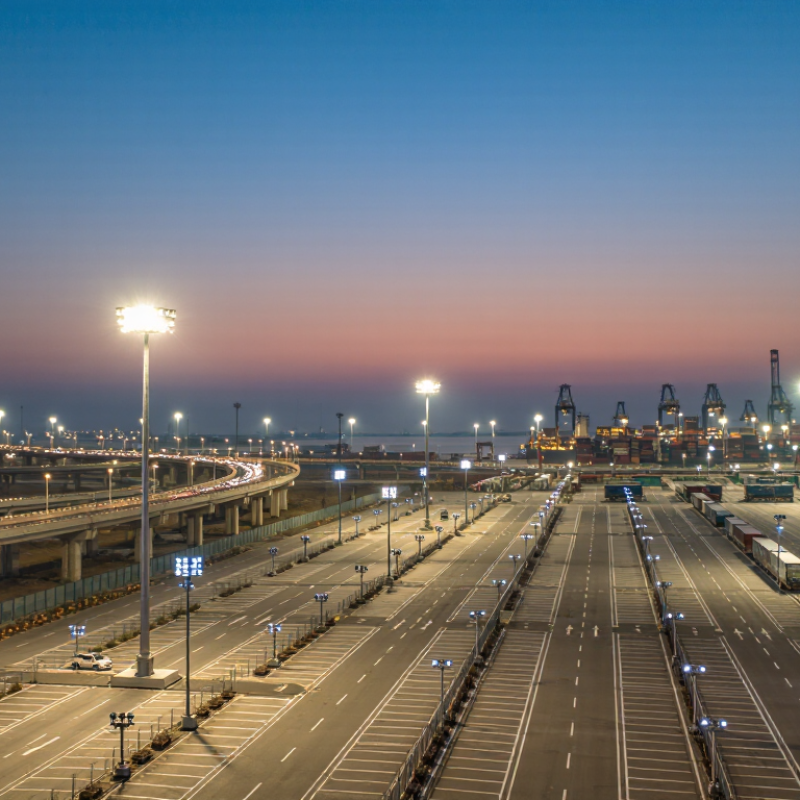
Table of Contents [Hide]
How High Mast Lighting Systems Are Classified
High mast lighting systems are commonly classified by how their luminaires are mounted and maintained. Fixed-head systems place floodlights on a crown near the top of the pole. A lowering system brings the luminaire ring down for inspection, often using a winch and cable. This can reduce work at height, but the mechanism itself needs regular checks. Some poles use fixed platforms or access ladders instead. The right arrangement depends on site access, maintenance resources, and the surrounding environment.
Optics provide another useful classification. Symmetric floodlights spread light broadly around an area, while asymmetric optics direct more light toward a road, yard, or apron. Choosing between them involves more than brightness. A lighting designer should consider pole spacing, mounting height, surface reflectance, and unwanted spill. Small aiming errors can leave dark patches beneath a tall mast.
Systems can also be grouped by light source and control method. LED luminaires are widely used for efficient operation and flexible dimming; older installations may use discharge lamps. Controls range from basic photocells to scheduled or remotely managed dimming. These categories overlap. A tidy label can hide practical trade-offs, and sometimes the simplest setup is easier to maintain. Check the actual light distribution and service plan before comparing system types.

© Copyright - Pro Tool & Supply - Site by SVM E-Marketing Solutions - Sitemap
- Privacy policy