- Products
- Air Compressors & Air Tools
- Climate Control
- Compaction Equipment
- Concrete Cutting Tools & Equipment
- Concrete and Masonry
- Demolition & Excavation
- Electrical & Mechanical
- Fasteners and Anchoring Adhesives
- Floor Protection
- Generators and Welders
- Hand Tools
- Heaters
- Janitorial and Office Supplies
- Jobsite Protection
- Ladders & Storage
- Lighting & Lighting Accessories
- Man Lifts
- Material Handling Equipment
- Power Tools
- Pressure Washers & Pumps
- Safety Gear
- Safety Products
- Saws
- Surface Preparation
- SEASONAL PRODUCTS
- Rentals
- Air Compressor and Air Tool Rentals
- Climate Control Rental
- Compaction Rentals
- Concrete Equipment Rentals
- Demolition & Excavation Equipment Rentals
- Concrete Floor Grinder Rentals
- General Construction Equipment Rentals
- Generator Rentals and Welder Rentals
- Heater Rentals
- Light Tower Rentals
- Man Lift Rentals in Massachusetts and Rhode Island
- Material Handling Equipment Rentals
- Pressure Washer & Pump Rentals
- Saw Rentals in New England
- SEASONAL PRODUCTS
- Products
- Air Compressors & Air Tools
- Climate Control
- Compaction Equipment
- Concrete Cutting Tools & Equipment
- Demolition & Excavation
- Electrical & Mechanical
- Floor Protection
- Generators and Welders
- Construction Heaters
- Construction Ladders, Staging, & Storage
- Construction Lighting
- Man Lifts
- Material Handling Equipment
- Industrial Janitorial and Office Supplies
- Pressure Washers & Pumps
- Construction Safety Products
- Construction Safety Gear
- Surface Preparation
- Building Protection
- Diesel Accessories
- Zero Emissions
- Rentals
- Air Compressor and Air Tool Rentals
- Climate Control Rental
- Compaction Rentals
- Concrete Equipment Rental
- Demolition & Excavation Equipment Rental
- General Construction Equipment Rental
- Generator Rentals and Welder Rentals
- Construction Heaters Rental
- Light Tower Rentals
- Man Lift Rentals
- Material Handling Equipment Rental
- Pressure Washer & Pump Rentals
- Saw Rentals in New England
- Concrete Floor Grinder Rentals
- Zero Emissions Rentals
- Repairs & Used
- Parts
- Blog
- Services
- Resources
- About Us
- Contact Us
Sales & Rental of Construction | Industrial Equipment & Supplies


What Is the Best 2.8 Inch TFT LCD Display?
Choosing the best 2.8 Inch TFT LCD Display requires more than comparing resolution or price. Engineers must match the screen with the product’s enclosure, processor, power budget, and operating environment. A compact industrial controller may need strong sunlight readability. A handheld instrument may prioritize low power and responsive touch input. These needs rarely point to the same model.
Recent industry research supports this practical approach. Omdia’s Display Long-Term Demand Outlook highlights continuing demand for small and medium displays across industrial, automotive, and consumer applications. TrendForce’s 2024 display supply-chain analyses also emphasize panel availability, production consistency, and component costs. These factors can affect long-term purchasing decisions, especially when a product requires stable supply for several years. Market research from Mordor Intelligence similarly describes TFT LCD technology as a mature segment with broad application coverage, but maturity does not guarantee identical quality between suppliers.
Look closely at the details. A 320 × 240 panel may be adequate for simple readings, while a 480 × 640 panel can show sharper menus and graphs. Brightness, contrast, viewing angle, connector position, and controller compatibility deserve equal attention. Mechanical fit matters too. A one-millimeter mismatch can force a redesigned bezel.
There is no universal winner. That is the uncomfortable part. Some specifications look excellent on paper but perform poorly behind tinted plastic or under direct sunlight. Reliable evaluation should combine datasheet evidence, sample testing, supplier experience, and lifecycle support. This guide examines those practical criteria to identify which 2.8 Inch TFT LCD Display best fits each application.
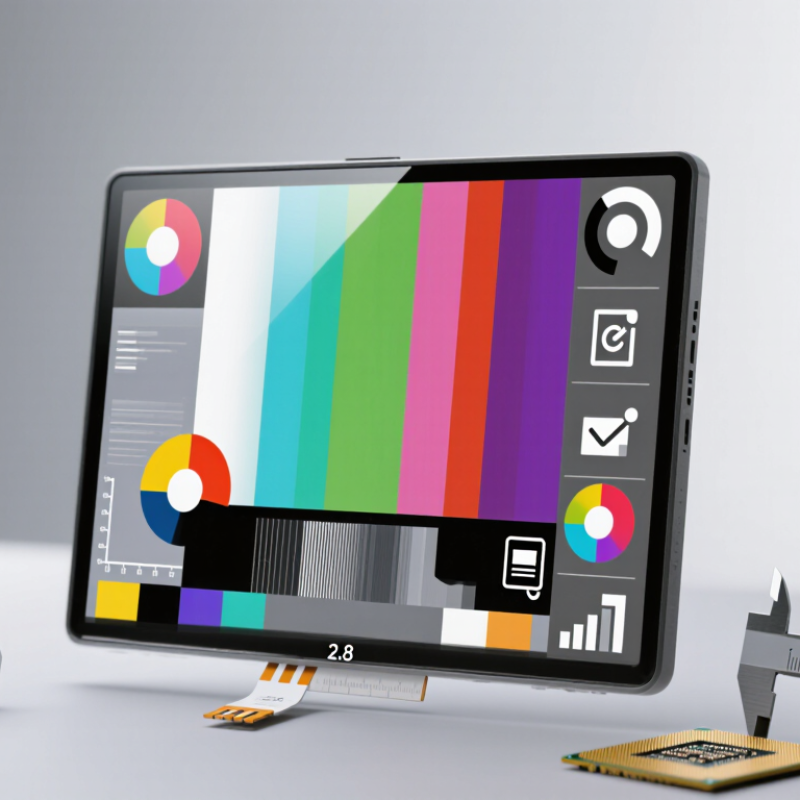
Table of Contents [Hide]
8-Inch TFT LCD Display: Definition and Core Features
When comparing the best 2.8-inch TFT LCD display, an 8-inch TFT LCD offers a different working experience. It provides a larger active viewing area for dashboards, control panels, medical instruments, and embedded interfaces. TFT means thin-film transistor, where each pixel has an individual switching element. This active-matrix structure improves response speed, image stability, and color control.
An 8-inch panel commonly uses a 16:9 or 4:3 aspect ratio. Typical resolutions include 800×480 and 1024×600 pixels. Brightness often ranges from 300 to 1,000 cd/m², depending on indoor or outdoor use. According to Omdia’s display market research, automotive and industrial applications continue increasing demand for medium-sized display panels. Grand View Research also reported steady growth in the global TFT-LCD market, supported by smart equipment and human-machine interfaces.
Size alone is not enough. Viewing angle, touch sensitivity, operating temperature, and interface compatibility require careful testing. Capacitive touch feels smooth, but gloves or moisture may reduce accuracy. Sunlight readability can improve with optical bonding, although costs and repair difficulty may rise. I have seen a bright display fail because its connector loosened under vibration. Small details matter.
Some specifications remain easy to misunderstand. A high resolution does not guarantee clear text if the software scales poorly. Engineers should test the panel with the final enclosure, cable length, and lighting conditions. An 8-inch display is practical, but not automatically the best choice.

© Copyright - Pro Tool & Supply - Site by SVM E-Marketing Solutions - Sitemap
- Privacy policy