- Products
- Air Compressors & Air Tools
- Climate Control
- Compaction Equipment
- Concrete Cutting Tools & Equipment
- Concrete and Masonry
- Demolition & Excavation
- Electrical & Mechanical
- Fasteners and Anchoring Adhesives
- Floor Protection
- Generators and Welders
- Hand Tools
- Heaters
- Janitorial and Office Supplies
- Jobsite Protection
- Ladders & Storage
- Lighting & Lighting Accessories
- Man Lifts
- Material Handling Equipment
- Power Tools
- Pressure Washers & Pumps
- Safety Gear
- Safety Products
- Saws
- Surface Preparation
- SEASONAL PRODUCTS
- Rentals
- Air Compressor and Air Tool Rentals
- Climate Control Rental
- Compaction Rentals
- Concrete Equipment Rentals
- Demolition & Excavation Equipment Rentals
- Concrete Floor Grinder Rentals
- General Construction Equipment Rentals
- Generator Rentals and Welder Rentals
- Heater Rentals
- Light Tower Rentals
- Man Lift Rentals in Massachusetts and Rhode Island
- Material Handling Equipment Rentals
- Pressure Washer & Pump Rentals
- Saw Rentals in New England
- SEASONAL PRODUCTS
- Products
- Air Compressors & Air Tools
- Climate Control
- Compaction Equipment
- Concrete Cutting Tools & Equipment
- Demolition & Excavation
- Electrical & Mechanical
- Floor Protection
- Generators and Welders
- Construction Heaters
- Construction Ladders, Staging, & Storage
- Construction Lighting
- Man Lifts
- Material Handling Equipment
- Industrial Janitorial and Office Supplies
- Pressure Washers & Pumps
- Construction Safety Products
- Construction Safety Gear
- Surface Preparation
- Building Protection
- Diesel Accessories
- Zero Emissions
- Rentals
- Air Compressor and Air Tool Rentals
- Climate Control Rental
- Compaction Rentals
- Concrete Equipment Rental
- Demolition & Excavation Equipment Rental
- General Construction Equipment Rental
- Generator Rentals and Welder Rentals
- Construction Heaters Rental
- Light Tower Rentals
- Man Lift Rentals
- Material Handling Equipment Rental
- Pressure Washer & Pump Rentals
- Saw Rentals in New England
- Concrete Floor Grinder Rentals
- Zero Emissions Rentals
- Repairs & Used
- Parts
- Blog
- Services
- Resources
- About Us
- Contact Us
Sales & Rental of Construction | Industrial Equipment & Supplies


What Are the 2026 Top Solar Energy Light Pole Types?
As cities pursue lower-carbon infrastructure, the solar energy light pole is becoming more adaptable, intelligent, and application-specific. In 2026, buyers will likely compare several leading designs rather than choose one universal solution. Integrated all-in-one poles combine panels, batteries, controllers, and LED fixtures in a compact housing. Split-type systems separate these components, allowing larger panels and easier servicing. Vertical photovoltaic poles can perform better where roof-like panel angles face heavy snow, dust, or limited space.
Other important options include smart solar poles with remote monitoring, motion sensors, adaptive dimming, and emergency communication functions. Hybrid solar-wind poles may suit coastal or exposed areas, although added mechanical parts can increase maintenance needs. Decorative and high-mast versions also deserve attention, especially for parks, highways, campuses, and public squares. Each type has a different balance of brightness, autonomy, appearance, durability, and installation cost.
Practical selection begins with the site. Consider sunlight hours, winter temperatures, wind load, soil conditions, traffic patterns, and nighttime safety requirements. Battery capacity should match expected cloudy periods, not only average weather. Check LED output, photovoltaic efficiency, IP and IK protection, controller quality, and local installation standards. Real projects often reveal gaps between catalog figures and field performance.
There is no perfect pole.
Some predicted 2026 trends may develop unevenly. Therefore, this guide compares the top types through measurable specifications, maintenance experience, and realistic use cases. It also highlights compromises, because reliable lighting depends on careful design more than impressive marketing.
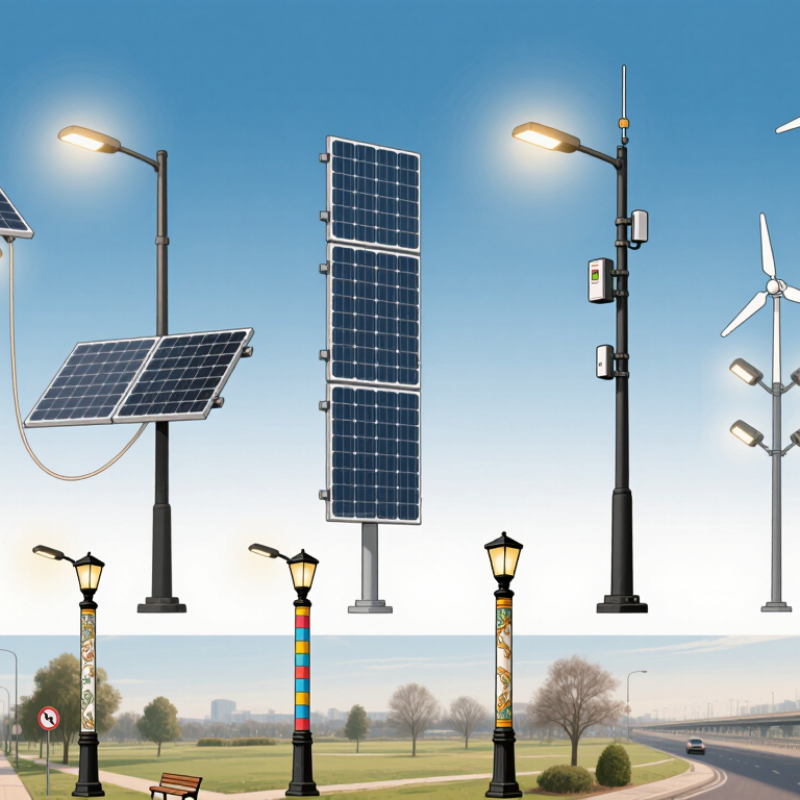
Table of Contents [Hide]
Solar Energy Light Poles: Definition, Structure, and Operating Principles
What Are the 2026 Top Solar Energy Light Pole Types?
Solar energy light poles are outdoor lighting systems that generate and store electricity on site. They usually combine a photovoltaic panel, lithium battery, charge controller, LED lamp, pole, and foundation. During daylight, the panel converts sunlight into electricity. The controller manages charging and protects the battery. After dusk, a light sensor activates the LED fixture.
In 2026, common designs include all-in-one poles, split-type poles, hybrid solar poles, and smart modular poles. All-in-one models place the panel, battery, and lamp in one compact housing. Split systems separate the panel from the lamp, which helps when shade affects the installation area. Hybrid poles can connect to the grid during extended cloudy periods. Smart modular poles may adjust brightness through motion sensors or remote monitoring. Field experience shows that layout matters as much as rated power. A larger panel cannot fully solve heavy shade or poor orientation.
Tips: Check winter sunlight, battery capacity, wind loading, and soil conditions before choosing a pole. Keep the panel clear of dust and nearby branches. Confirm the controller includes low-voltage protection. A high wattage label can mislead. Real sites are rarely perfect. Drainage, salt air, and uneven pavement may shorten service life, so inspection records deserve attention. A careful design review often prevents expensive foundation changes later.

© Copyright - Pro Tool & Supply - Site by SVM E-Marketing Solutions - Sitemap
- Privacy policy