- Products
- Air Compressors & Air Tools
- Climate Control
- Compaction Equipment
- Concrete Cutting Tools & Equipment
- Concrete and Masonry
- Demolition & Excavation
- Electrical & Mechanical
- Fasteners and Anchoring Adhesives
- Floor Protection
- Generators and Welders
- Hand Tools
- Heaters
- Janitorial and Office Supplies
- Jobsite Protection
- Ladders & Storage
- Lighting & Lighting Accessories
- Man Lifts
- Material Handling Equipment
- Power Tools
- Pressure Washers & Pumps
- Safety Gear
- Safety Products
- Saws
- Surface Preparation
- SEASONAL PRODUCTS
- Rentals
- Air Compressor and Air Tool Rentals
- Climate Control Rental
- Compaction Rentals
- Concrete Equipment Rentals
- Demolition & Excavation Equipment Rentals
- Concrete Floor Grinder Rentals
- General Construction Equipment Rentals
- Generator Rentals and Welder Rentals
- Heater Rentals
- Light Tower Rentals
- Man Lift Rentals in Massachusetts and Rhode Island
- Material Handling Equipment Rentals
- Pressure Washer & Pump Rentals
- Saw Rentals in New England
- SEASONAL PRODUCTS
- Products
- Air Compressors & Air Tools
- Climate Control
- Compaction Equipment
- Concrete Cutting Tools & Equipment
- Demolition & Excavation
- Electrical & Mechanical
- Floor Protection
- Generators and Welders
- Construction Heaters
- Construction Ladders, Staging, & Storage
- Construction Lighting
- Man Lifts
- Material Handling Equipment
- Industrial Janitorial and Office Supplies
- Pressure Washers & Pumps
- Construction Safety Products
- Construction Safety Gear
- Surface Preparation
- Building Protection
- Diesel Accessories
- Zero Emissions
- Rentals
- Air Compressor and Air Tool Rentals
- Climate Control Rental
- Compaction Rentals
- Concrete Equipment Rental
- Demolition & Excavation Equipment Rental
- General Construction Equipment Rental
- Generator Rentals and Welder Rentals
- Construction Heaters Rental
- Light Tower Rentals
- Man Lift Rentals
- Material Handling Equipment Rental
- Pressure Washer & Pump Rentals
- Saw Rentals in New England
- Concrete Floor Grinder Rentals
- Zero Emissions Rentals
- Repairs & Used
- Parts
- Blog
- Services
- Resources
- About Us
- Contact Us
Sales & Rental of Construction | Industrial Equipment & Supplies


2026 Top Rail Freight Companies for Global Buyers
Global buyers evaluating the 2026 Top Rail Freight Companies need more than a list of famous names. Rail Freight can move large volumes across long distances, but performance depends on the route, service frequency, terminal access, and connections to ports or warehouses. A container may cross a continent smoothly, then lose time waiting for a transfer slot. Details matter. This guide compares providers by network reach, reliability, transit visibility, equipment options, and customer support. It also considers whether a carrier can coordinate the first and last miles, not just the train journey.
Keith Creel, president and chief executive of Canadian Pacific Kansas City, has described its network as “the only railroad that connects Canada, the U.S. and Mexico.” That cross-border reach illustrates why network design matters to shippers. It does not, by itself, prove that one company suits every buyer. Not every route fits. Buyers should check published schedules, capacity commitments, terminal locations, handoff procedures, and the quality of shipment updates before choosing a partner. Compare total service needs, not just advertised transit times or headline rates. A missed connection can change the calculation. The rankings that follow are a starting point, not a substitute for route-specific checks. Some comparisons also rely on information that changes over time; that limitation deserves attention.
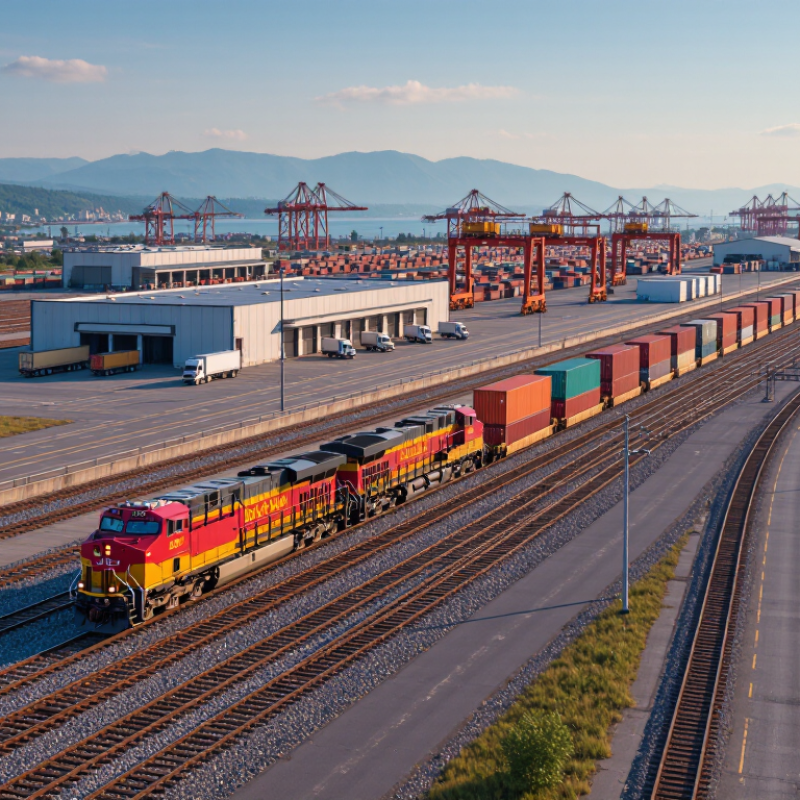
Table of Contents [Hide]
How Rail Freight Supports Global Trade in 2026
In 2026, rail freight helps connect inland factories, distribution centers, and seaports across major trade corridors. It can offer steadier transit times than road on long overland routes, while moving large volumes of goods efficiently. For importers, predictable schedules make it easier to plan inventory and coordinate rail arrivals with ocean or truck transport. Rail is not automatically the fastest option. A missed connection or a busy terminal can erase days of expected savings.
Reliable planning starts with shipment details. Confirm the cargo’s weight, dimensions, packaging, and delivery deadline before comparing routes. Check terminal locations, transfer times, and how tracking updates are shared. A timetable is useful, but actual performance also depends on congestion, weather, and local handling capacity. Delays still happen.
Tips: Ask providers for recent transit-time ranges, not just best-case estimates. Leave a buffer around port transfers, and identify who will report exceptions. Keep documents and shipment references consistent across transport partners. That matters. Small errors can slow a handoff, even when the train runs on schedule. Rail works best as part of a coordinated plan, with a practical backup for the first and last mile.
| Market or Corridor | Network Facts | Typical Freight Fit | How Rail Supports Trade | Buyer Checks for 2026 |
|---|---|---|---|---|
| China–Europe Eurasian routes | Routes may cross networks using 1,435 mm standard gauge and 1,520 mm broad gauge. Gauge changes require suitable border-terminal handling, such as cargo transfer or other gauge-transition arrangements. | Containerized manufactured goods, components, and other cargo suitable for scheduled intermodal transport. | Provides a land-based option between Asian and European logistics hubs, alongside ocean and Air Freight. | Confirm the exact route, border-handling method, transit plan, customs procedures, cargo restrictions, and current service availability. |
| Trans-Siberian route | The Trans-Siberian Railway links western Russia with the Russian Far East; the Russian network uses 1,520 mm broad gauge. | Containerized and other rail-compatible cargo moving between connected inland and port locations. | Connects inland freight flows with Russian Far East gateways and onward connections where available. | Check end-to-end routing, transshipment requirements, border and port connections, sanctions compliance, insurance, and current operating conditions. |
| European cross-border rail | Most core rail routes use 1,435 mm standard gauge, although gauge and operating conditions differ in some regions. Cross-border operations can also involve differing technical and regulatory requirements. | Intermodal containers, industrial inputs, finished goods, and other freight suited to rail or combined transport. | Connects inland terminals, industrial regions, ports, and neighboring national markets. | Verify terminal access, border procedures, train path and capacity, local operating rules, and first- and last-mile arrangements. |
| North American rail freight networks | Rail networks in the United States, Canada, and Mexico use 1,435 mm standard gauge. International movements may involve interchange between separate rail networks. | Intermodal containers, agricultural products, minerals, energy-related freight, vehicles, and industrial commodities. | Supports long-distance inland movement and connections between production areas, distribution hubs, border crossings, and ports. | Confirm network handoffs, border documentation, equipment availability, terminal locations, and road connections at origin and destination. |
| India’s broad-gauge network and dedicated freight corridors | India’s principal broad-gauge network uses 1,676 mm gauge. Dedicated freight corridors are being developed and commissioned in sections; availability depends on the route segment. | Domestic containerized cargo, bulk commodities, and industrial freight compatible with the available route and equipment. | Provides inland links between production and consumption centers, logistics terminals, and ports. | Check which corridor segments are operational for the shipment, loading limits, terminal access, equipment, schedules, and onward connections. |
Route characteristics are general network facts, not guaranteed service specifications. Transit time, capacity, pricing, and availability depend on the selected operator, route, terminal, border conditions, and shipment requirements; obtain a current, shipment-specific quotation before booking.

© Copyright - Pro Tool & Supply - Site by SVM E-Marketing Solutions - Sitemap
- Privacy policy