- Products
- Air Compressors & Air Tools
- Climate Control
- Compaction Equipment
- Concrete Cutting Tools & Equipment
- Concrete and Masonry
- Demolition & Excavation
- Electrical & Mechanical
- Fasteners and Anchoring Adhesives
- Floor Protection
- Generators and Welders
- Hand Tools
- Heaters
- Janitorial and Office Supplies
- Jobsite Protection
- Ladders & Storage
- Lighting & Lighting Accessories
- Man Lifts
- Material Handling Equipment
- Power Tools
- Pressure Washers & Pumps
- Safety Gear
- Safety Products
- Saws
- Surface Preparation
- SEASONAL PRODUCTS
- Rentals
- Air Compressor and Air Tool Rentals
- Climate Control Rental
- Compaction Rentals
- Concrete Equipment Rentals
- Demolition & Excavation Equipment Rentals
- Concrete Floor Grinder Rentals
- General Construction Equipment Rentals
- Generator Rentals and Welder Rentals
- Heater Rentals
- Light Tower Rentals
- Man Lift Rentals in Massachusetts and Rhode Island
- Material Handling Equipment Rentals
- Pressure Washer & Pump Rentals
- Saw Rentals in New England
- SEASONAL PRODUCTS
- Products
- Air Compressors & Air Tools
- Climate Control
- Compaction Equipment
- Concrete Cutting Tools & Equipment
- Demolition & Excavation
- Electrical & Mechanical
- Floor Protection
- Generators and Welders
- Construction Heaters
- Construction Ladders, Staging, & Storage
- Construction Lighting
- Man Lifts
- Material Handling Equipment
- Industrial Janitorial and Office Supplies
- Pressure Washers & Pumps
- Construction Safety Products
- Construction Safety Gear
- Surface Preparation
- Building Protection
- Diesel Accessories
- Zero Emissions
- Rentals
- Air Compressor and Air Tool Rentals
- Climate Control Rental
- Compaction Rentals
- Concrete Equipment Rental
- Demolition & Excavation Equipment Rental
- General Construction Equipment Rental
- Generator Rentals and Welder Rentals
- Construction Heaters Rental
- Light Tower Rentals
- Man Lift Rentals
- Material Handling Equipment Rental
- Pressure Washer & Pump Rentals
- Saw Rentals in New England
- Concrete Floor Grinder Rentals
- Zero Emissions Rentals
- Repairs & Used
- Parts
- Blog
- Services
- Resources
- About Us
- Contact Us
Sales & Rental of Construction | Industrial Equipment & Supplies


What Are the 2026 Best Commercial Wall Lights for Buyers?
Choosing the 2026 best Commercial Wall Lights requires more than comparing brightness, finishes, or online prices. Buyers must examine how each fixture performs beside a hotel entrance, along a retail corridor, or above a damp restaurant terrace. A wall light can look impressive in a product photograph and still create harsh glare on a customer’s face.
Richard Kelly, a pioneering architectural lighting designer, wrote, “Light is the only thing that makes architecture visible.” His observation remains useful for commercial buyers. The right fixture should reveal textures, guide movement, support safety, and strengthen a building’s identity without overwhelming its architecture. Look closely at beam angle, color temperature, lumen output, shielding, dimming compatibility, and ingress protection. These details matter after installation, not only during specification.
This guide examines Commercial Wall Lights through a practical buyer’s lens. It considers LED efficiency, weather resistance, maintenance access, mounting stability, and visual comfort. It also compares styles, including up-and-down lights, recessed wall fixtures, surface-mounted cylinders, and decorative exterior sconces. Small differences become obvious at night. A narrow beam may highlight brick beautifully, while a poorly aimed fitting can spill light into neighboring windows.
No checklist is perfect. That matters. Site conditions, local standards, and user expectations can change the final decision. Buyers should request photometric data, verify warranty terms, and test samples whenever possible. The best fixture is not always the brightest or most expensive. It is the one that remains reliable, comfortable, and visually appropriate after months of real commercial use.
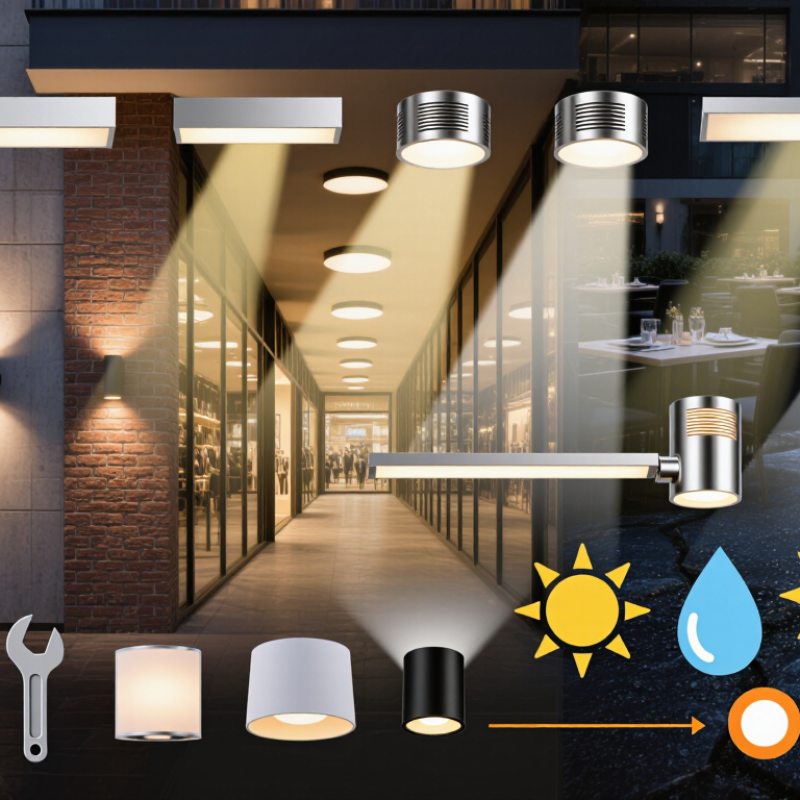
Table of Contents [Hide]
Commercial Wall Light Types: LED, Sconce, Bulkhead, and Area-Lighting Designs
Commercial wall lights in 2026 need more than high brightness. Buyers should match each type to its working environment.
LED wall lights provide efficient, even illumination for corridors, loading entrances, and service areas. Look for clear lumen data, color temperature, glare control, and replaceable drivers. A 3000K to 4000K range often keeps surfaces readable without making staff feel exposed. Inspect the surface. In site reviews, I have seen efficient fixtures fail when heat collects behind sealed panels.
Sconces suit hotels, offices, and retail exteriors where appearance matters beside directional light. Their shades can soften faces, but decorative forms may trap dust or complicate cleaning. Inspect the IP rating, lens access, and wiring space before purchasing.
Bulkhead lights are practical for workshops, parking structures, stairwells, and coastal service zones. Choose impact-resistant housings and sealed gaskets where moisture, grit, or accidental contact is likely. Rugged is not always comfortable. A harsh lens can create dark steps and distracting reflections.
Area-lighting wall designs spread illumination across yards, paths, and building perimeters. They work best when beam angle, mounting height, and nearby windows are assessed together. Photocells, occupancy controls, and dimming can reduce wasted energy, but controls require commissioning. Ask for photometric files and warranty terms, not only attractive catalog photographs. Accessible terminals, corrosion-resistant fasteners, and temperature-rated drivers also matter. Test one sample. Real walls often expose assumptions.

© Copyright - Pro Tool & Supply - Site by SVM E-Marketing Solutions - Sitemap
- Privacy policy